Sintered Powder vs Wire Mesh vs Metal Fiber Felt
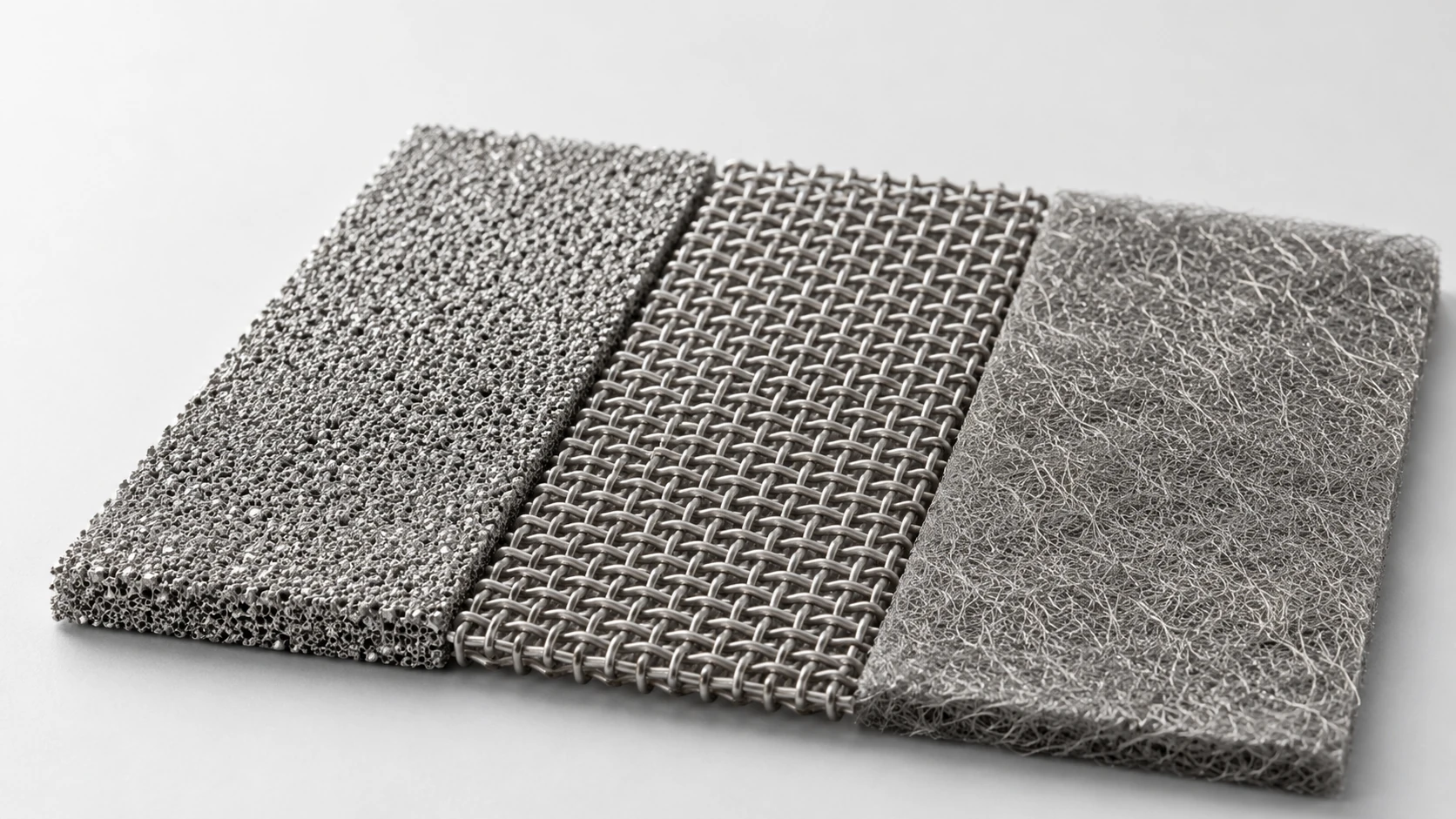
Sintered metal powder, sintered wire mesh and metal fiber felt can all produce durable, cleanable metal filters, but they do not behave the same way. The right choice depends on filtration mechanism, flow, pressure drop, dirt loading, cleaning, mechanical support, available geometry and total operating cycle.
Rigid porous shapes and controlled three-dimensional pore paths
Layered screen structures, strength and surface-oriented capture
High-porosity depth media with strong dirt-loading potential
Which Metal Filter Media Should You Choose?
There is no universal winner. Start with the contaminant and cleaning cycle, then eliminate media that do not fit the required geometry or mechanical conditions.
| Factor | Sintered metal powder | Sintered wire mesh | Metal fiber felt |
|---|---|---|---|
| Basic structure | Bonded metal particles with interconnected pores | Woven wire layers bonded at contact points | Random metal fibers bonded into a three-dimensional matrix |
| Typical filtration behavior | Tortuous porous path; can provide depth capture depending on grade and thickness | More surface-oriented capture at a defined control layer | Depth loading through a fibrous matrix |
| Geometry strength | Strong for rigid discs, tubes, cups and compact shapes | Strong layered sheet media; good for formed cylinders and cartridges with correct support | Usually used with support structures; excellent for pleated high-area elements |
| Dirt-loading tendency | Depends strongly on pore size, thickness and contaminant; fine solids can load through the depth | Good when retained solids build a releasable surface cake | Often strong for distributed fine-particle loading through the media depth |
| Cleaning | Can be backflushed, ultrasonically or chemically cleaned where the application allows; embedded solids may be harder to remove | Often well suited to backwash and surface cleaning | Cleanable, but deep contaminant penetration must be considered |
| Common forms | Discs, tubes, cups, plugs, bushings, cylinders, cartridges | Sheets, discs, cylinders, cartridges, candles, screens | Sheets, discs and especially pleated cartridges/elements |
| Best starting point | Rigid self-supporting porous components and drawing-specific shapes | Reusable layered filter structures needing mechanical stability and defined screen behavior | High-area elements where porosity and dirt-holding capacity are priorities |
| Micron and retention definition | Particle-removal efficiency or pore-grade method must be specified; a nominal pore value is not a validated absolute removal rating. | Mesh count, wire diameter, weave and calibrated filtration opening are different descriptors; ask for a performance test where removal efficiency matters. | Felt grade, depth structure and actual particle-retention efficiency must be qualified under the stated challenge and flow conditions. |
| Clean-flow hydraulic comparison | Compare pressure drop at the requested gas or liquid flow, viscosity/temperature, wall thickness and exposed area. | Check the same conditions, control-layer weave, support layers and assembled element area. | Compare actual pleat geometry, available area and compressed or supported media condition. |
| End connections and housing | Confirm seamless body, machined features, O-ring or other customer housing seal as specified. | Confirm weld seam, support layers, end fittings, flow direction and housing gasket interface. | Confirm support cage, seam weld, pleat stabilization and the finished cartridge-to-housing seal. |
| Acceptance evidence | Request defined dimensional, media-integrity, pressure-drop or retention evidence only where needed by the order. | Specify layer construction, dimensional tolerances, weld/joint checks and conditional flow/retention verification. | Specify media structure, pleat geometry, integrity, pressure-drop and loading/cleaning evaluation conditions. |
When Sintered Metal Powder Is the Better Fit
Sintered metal powder filters are produced by compacting metal powder and sintering it into a rigid porous body. Because the porous structure is the body itself, the process can create compact three-dimensional shapes without starting from a woven sheet.
This is useful for porous cups, thick discs, small tubes, plugs, bushings, silencers and other parts where the geometry needs to remain rigid and porous through a defined wall thickness.
Powder is a strong candidate when:
- The part needs a self-supporting porous shape.
- The design is too thick or three-dimensional for ordinary sheet media.
- Distributed flow through a compact porous wall is required.
- Machined or integrated mounting features are part of the design.
Watch: fine grades, thick walls and small filtration area can increase pressure drop. Cleaning recovery also depends on how deeply contaminants enter the pore network.
When Sintered Wire Mesh Is the Better Fit
Sintered wire mesh starts with woven metal mesh. Multiple layers can be arranged for filtration, drainage, protection and support, then sintered so the contacts become a stable bonded laminate.
The ordered woven structure makes mesh attractive when the system benefits from a defined screen layer, mechanical support, formed sheet geometry and a contaminant cake that can be released from the surface.
Wire mesh is a strong candidate when:
- Backwash or surface cleaning is central to the operating cycle.
- The element must be formed from sheet into a cylinder, disc or cartridge.
- A layered support and control structure is desirable.
- Mechanical stability and reusable screen behavior are priorities.
Watch: mesh count, aperture and micron rating are not interchangeable terms. Performance depends on weave, layer stack, wire diameter and test method.
When Metal Fiber Felt Is the Better Fit
Metal fiber felt uses fine metal fibers laid into a random three-dimensional structure and bonded by sintering. The fibrous network can provide high porosity and a depth-loading path, and it can be pleated to place substantial filtration area inside a compact housing.
This makes felt attractive for demanding gas or liquid duties where fine contaminant loading, filtration area and dirt-holding capacity are more important than a simple surface screen.
Fiber felt is a strong candidate when:
- Depth loading of fine particles is desirable.
- A pleated cartridge can add useful filtration area.
- High porosity is valuable for the duty.
- The process requires durable metal media rather than disposable fiber or polymer elements.
Watch: embedded contamination can be harder to remove than a surface cake, and the media normally needs appropriate support and element construction.
Compare the Finished Element Under the Same Test Conditions
Powder, woven mesh and metal fiber felt are media families, not interchangeable performance ratings. A sound comparison uses the actual finished element, fluid, particle challenge and cleaning cycle. Begin by defining the process duty and acceptance method.
Retention Is a Test Result, Not Just a Micron Label
State the target particle size, challenge material and the allowable downstream solids. Distinguish media pore grade, a nominal filtration description and a measured efficiency or absolute rating; methods from different suppliers are not directly interchangeable.
When an efficiency claim is required, agree on the upstream and downstream test method, flow and pass/fail criterion for the finished element.
Compare Pressure Drop at Matched Flow and Area
Define gas or liquid composition, flow basis, temperature, viscosity or density, exposed area, flow direction and clean-element differential pressure. Request an element-level comparison, not a porosity value divorced from thickness, geometry and support.
Also set the loaded pressure-drop trigger and maximum allowable differential pressure before selecting fine grades or compact elements.
Prove Cleaning Recovery and Assembly Fit
Particle shape and concentration affect cake release, depth loading and fouling. Review backpulse, backwash, chemical, ultrasonic or replacement plans against the selected alloy and bonded structure.
Specify the end fittings, seam or support structure, housing seal, drawing revision and dimensional or integrity inspections needed for repeatable OEM supply.
Selection boundary: Metal fiber felt can offer greater area when pleated, layered wire mesh can provide a defined woven control structure, and powder media can form rigid porous geometry. None of these descriptions guarantees a pressure rating, micron removal efficiency, operating temperature, cleaning recovery or service life without a defined material and test.
Choose by Failure Mode, Not by Media Name
Start with Contaminant
Define particle size distribution, concentration, shape and whether solids form a surface cake or penetrate the medium.
Set the Flow Window
Provide flow rate, fluid properties and allowable clean and loaded pressure drop.
Define Cleaning
Backwash, reverse flow, ultrasonic, solvent, chemical or thermal cleaning may favor different media.
Lock the Geometry
Housing space, filtration area, wall thickness, pleating, support and connection design can eliminate otherwise suitable options.
Typical Selection Patterns
| Need | Good starting point | Reason |
|---|---|---|
| Small rigid porous insert or cup | Sintered powder | Self-supporting three-dimensional porous geometry |
| Backwashable cylindrical screen | Sintered wire mesh | Layered screen construction and surface-oriented solids release |
| Pleated high-area metal cartridge | Metal fiber felt or mesh, depending on loading and cleaning | Both can be pleated; felt emphasizes depth loading, mesh emphasizes screen structure |
| Compact gas diffuser or restriction | Sintered powder | Distributed flow through a rigid porous wall |
| High dirt load of fine particles | Metal fiber felt | Three-dimensional fibrous depth path and high-area element options |
| Defined surface screening with repeated cleaning | Sintered wire mesh | Stable woven control layer and good inspectability |
| Limited allowable clean pressure drop at a fixed flow | Compare tested powder, mesh and felt element constructions | Actual grade, area, support and fluid conditions determine resistance; no universal lowest-pressure-drop family. |
| Repeated backpulse or backwash duty | Evaluate powder and layered mesh, plus qualifying felt structures | Verify cake release, media integrity and cleaning recovery at the specified pressure and contaminant loading. |
| OEM housing replacement with unusual end fittings | Select the media and connection as one finished assembly | Media choice alone cannot establish fit; document the connection, seal, flow direction and drawing tolerance. |
| Service with changing temperature or chemical composition | Recheck alloy and cleaning compatibility for every candidate | Material data and corrosion limits depend on the actual alloy, welded joints, exposure and cleaning agents. |
These are starting points, not universal rules. Final performance depends on the actual grade, area, thickness, support, fluid, contaminant and operating cycle.
Powder, Mesh and Fiber Felt Questions
Can I compare 10-micron powder, mesh and felt as equal-retention media?
Not without a shared test definition. A pore grade, mesh opening and fiber-felt filtration label may describe different measurements. Require a common particle challenge, flow and acceptance criterion when removal efficiency determines equipment protection.
Does high porosity always mean lower pressure drop?
No. The assembled element’s media grade, thickness, pleated area, supports, flow direction and fluid properties control pressure loss. Compare at a specified clean flow and track differential pressure as contaminants accumulate.
What information should an OEM buyer send to select among all three?
Provide the process fluid or gas, contaminants, retention target and definition, flow and temperature, allowable clean and loaded differential pressures, cleaning cycle, drawing and housing interface, alloy compatibility, quantity, and any required test records.
Which metal filter has the lowest pressure drop?
There is no fixed winner. Pressure drop depends on filtration grade, thickness, porosity or open area, support layers, element area, fluid properties, flow rate and contaminant loading. Compare media under the same operating conditions.
Which media is easiest to clean?
Sintered wire mesh is often a strong choice when solids remain at a surface and can be backwashed or removed as a cake. Powder and fiber felt are also cleanable, but deeply embedded contamination may require a more deliberate cleaning method.
Which media holds the most dirt?
Metal fiber felt is often selected for high dirt-holding potential because its random fibrous structure can load through the media depth. Actual capacity still depends on the grade, contaminant, thickness and element area.
Which media is strongest?
Strength cannot be compared from the media name alone. Powder forms can be very rigid in compact shapes, sintered mesh gains strength from bonded layers, and fiber felt is normally combined with suitable supports. Required differential pressure and geometry should drive the design.
Can one filter element combine more than one media type?
Yes. Finished metal elements can combine filtration media with support mesh, perforated metal, dense end hardware and other structures. The combination should be engineered around flow, strength, cleaning and assembly requirements.
Not Sure Which Metal Filter Media Fits?
Send your medium, contaminant, flow, filtration requirement, allowable pressure drop, temperature, pressure, cleaning method, dimensions and drawing. We can review powder, wire mesh and fiber felt routes against the actual duty.
For an element-level selection workflow, read our metal filter element specification guide. For custom manufacturing, review our factory capabilities and inspection process. The quotation should identify acceptance conditions before any performance guarantee is agreed.
Request an Engineering Review