Sintered Bronze Filters Manufacturer
METAVOX manufactures custom sintered bronze filters, porous bronze filter elements, bronze filter discs, tubes, cylinders, porous plugs, threaded filter components and custom powder-sintered parts for pneumatic, gas, air, oil, liquid and industrial filtration applications.
Products are specified according to shape, dimensions, filtration or pore requirement, thread or connection, operating flow, allowable differential pressure, system pressure, working medium, temperature, installation method, quantity and drawing requirements.
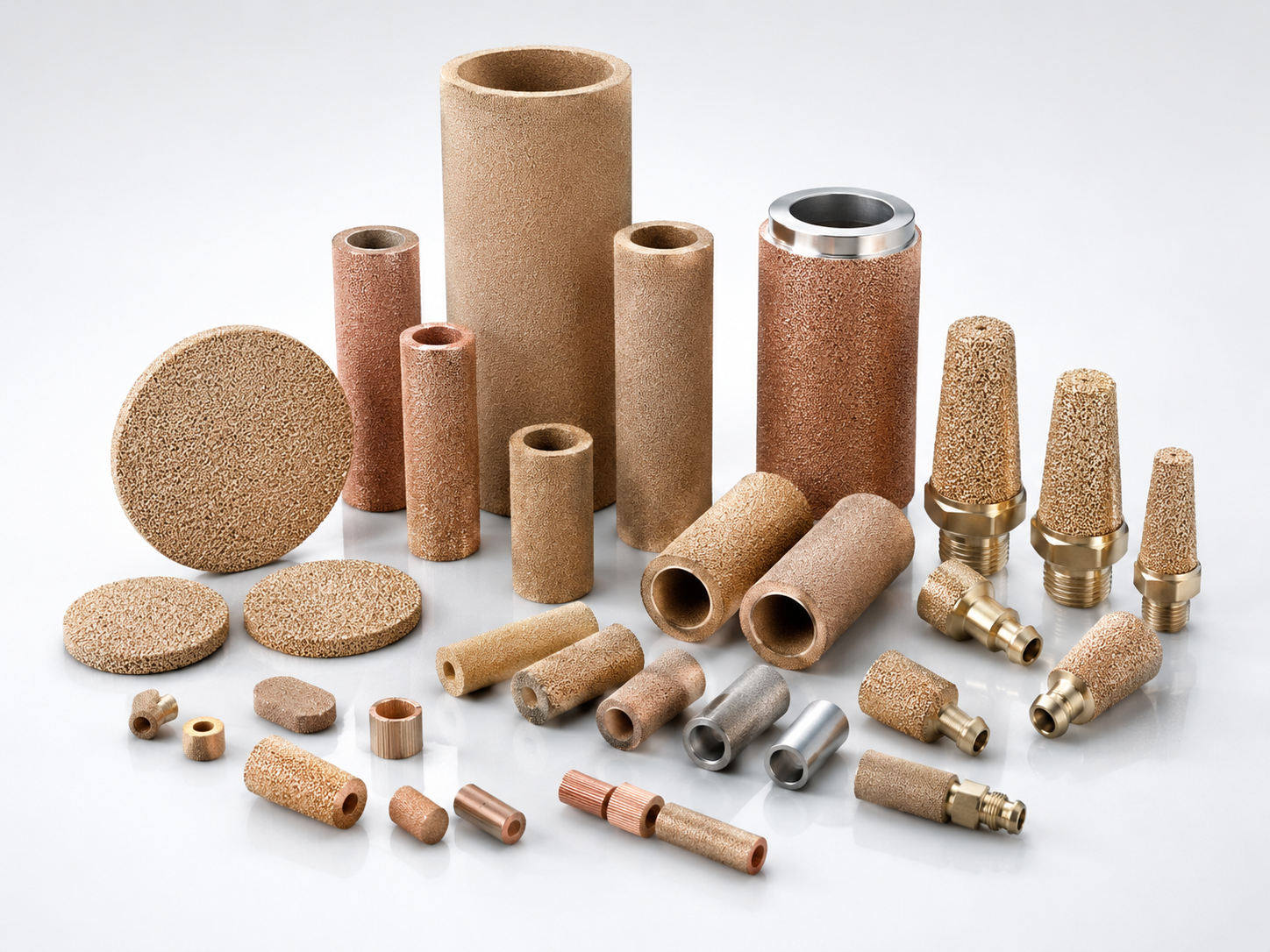
Custom Porous Bronze Filters for Industrial Applications
Sintered bronze filters use a rigid interconnected porous metal structure and are commonly selected for compact filtration, venting, pneumatic protection, oil and gas filtration, flow control and OEM equipment components.
Sintered Bronze Filter Elements
Porous bronze elements for industrial air, gas, oil, liquid and compact filtration assemblies, manufactured according to dimensions, filtration requirements and operating conditions.
Porous Bronze Filter Discs
Round or washer-shaped porous bronze discs manufactured according to outer diameter, thickness, center hole, filtration requirement and installation method.
Sintered Bronze Filter Tubes
Porous bronze tubes and cylindrical components for air, gas, oil, filtration, venting and controlled-flow applications.
Porous Bronze Filter Plugs
Compact cylindrical and plug-style porous bronze components for valves, regulators, pneumatic equipment and OEM assemblies.
Threaded Bronze Filter Elements
Threaded porous bronze filter components can be manufactured according to thread standard, connection geometry, airflow or liquid-flow requirements and available installation space.
Custom Bronze & Copper-Powder Components
Bronze, copper-powder and other copper-alloy porous components can be evaluated according to the specified material, drawing, dimensions and operating requirements.

Porous Bronze Structure Selected by Flow, Filtration and Geometry
Sintered bronze components are manufactured with an interconnected porous structure that allows gas or liquid to pass through the finished metal element.
Finished behavior depends on porous structure, component thickness, diameter, available filtration area, working medium and operating flow. The micron or pore requirement should therefore be evaluated together with the complete part geometry.
- Compact rigid porous bronze filter structures
- Custom disc, tube, cylinder, plug and threaded forms
- Dimensions and connections matched to the installation
- Flow and differential-pressure review for restriction-sensitive systems
- Drawing and sample review for replacement and custom components
Sintered Bronze Filter Sizes: Discs, Tubes and Plugs
Use these catalogue-based size examples to describe a replacement or a new bronze filter. Your final drawing, pore requirement and production feasibility determine the quotation.
Swipe horizontally to view all columns →
| Product form | Example dimensions, mm | Dimension order | What to specify |
|---|---|---|---|
| Flat bronze filter disc | Ø6 × 3; Ø10 × 3; Ø12 × 3; Ø21 × 3; Ø28 × 3; Ø38 × 3 | Outer diameter × porous thickness | Nominal grade, mounting fit, edge tolerance, order quantity |
| Hollow bronze filter tube | Ø17 OD × Ø10.8 ID × 16 L; Ø20 OD × Ø16 ID × 33.5 L; Ø30 OD × Ø24 ID × 40 L | Outer diameter × inner diameter × overall length | Open or closed end, flow direction, active porous length, grade |
| Bronze plug or solid porous insert | Ø6 × 3; Ø10 × 10; Ø12 × 15 as sizing examples | Diameter × porous length | Press-fit allowance, seating method, required flow and fit |
| Custom threaded filter part | Thread examples: M5, G1/8, G1/4, 1/8 NPT, 1/4 NPT | Named thread standard, size and end geometry | Male/female, pitch, sealing method, mating drawing, pressure duty |
Choose a bronze filter disc
Start with outer diameter and thickness. For a washer-shaped insert add center-hole diameter, seating surface and flow direction.
Example request: Bronze disc, Ø12 × 3 mm, nominal 40 μm inquiry grade, air service, sample quantity 20 pcs.
Specify a hollow bronze tube
Identify outer and inner diameters separately. For a uniform straight tube, the nominal radial wall thickness is (OD − ID) ÷ 2.
Example request: OD 20 mm, ID 16 mm, length 33.5 mm, bronze porous tube, target flow and medium specified.
Bronze Filter Disc — Dimensions
Porous Bronze Tube — Dimensions
Illustrative dimension guide only — not to scale and not an approved manufacturing drawing. Provide drawings, samples and connection details to confirm the actual part.
Bronze Filtration Grades and Flow Requirements
Compare nominal grade requests with the working medium, exposed area and clean-element pressure drop. A stated micron value alone does not confirm retention efficiency or usable flow.
10–100 μm Nominal Inquiry Options
Representative requests: 10, 20, 30, 40, 60, 80 and 100 μm. Grade definitions vary by powder construction; confirm the required particle-removal performance if it is critical.
Bronze Composition by Application
Specify the needed bronze alloy where known, such as CuSn8 or CuSn10, and identify corrosion exposure, process fluid and any material-document requirement. Other grades are reviewed separately.
Flow, Pressure Drop and Validation
Send gas or liquid type, operating flow, allowable initial ΔP, line pressure and temperature. Filtration grade and porous geometry must be assessed together.
Threaded Bronze Filter Elements: G, NPT and Metric Fit
For filter plugs and adapters, the thread standard and sealing interface are as important as the porous part. A nominal size such as “1/8” does not identify the thread form by itself.
G / BSPP and NPT are not interchangeable
G1/8 and G1/4 identify parallel BSPP thread examples; 1/8 NPT and 1/4 NPT identify tapered NPT examples. Provide the exact designation rather than replacing one with the other.
Show thread gender, length of engagement, seating face or seal and the mating port.
Metric and press-fit parts
M5 is a common small-thread inquiry size. For a plain press-fit bronze plug, supply the receiving bore diameter, target fit, porous length, insertion depth and preferred retention method.
When the main duty is compressed-air exhaust noise reduction, use the dedicated bronze pneumatic muffler page.
Sintered Bronze Filter Selection Data
Sintered bronze filters are manufactured in different shapes and porous configurations. Final specifications depend on material, dimensions, filtration requirement, flow and operating conditions.
Powder-Sintered Bronze
Bronze is available for powder-sintered porous filter components. Exact material composition and suitability should be confirmed against the working medium and operating conditions.
Common Bronze Filter Grade Requests
Bronze filter inquiries commonly specify nominal grades such as 10, 20, 30, 40, 60, 80 or 100 μm. The grade definition and feasible pore structure depend on the bronze part, dimensions and required performance.
Custom Dimensions and Connections
Diameter, length, thickness, center hole, thread, mounting interface and porous area are specified according to drawing and installation conditions.
| Technical Item | Typical / Available Basis | Engineering Consideration |
|---|---|---|
| Primary Structure | Rigid powder-sintered porous bronze component | Porous structure and geometry are selected according to filtration and flow requirements. |
| Material | Bronze powder-sintered construction | Confirm material suitability against working medium, corrosion and operating conditions. |
| Filtration Range | Common nominal inquiry grades: 10, 20, 30, 40, 60, 80 or 100 μm, subject to finished-part review | The usable range for an individual bronze component depends on dimensions, geometry and porous configuration. |
| Product Forms | Disc, tube, cylinder, porous plug, threaded element and custom porous part | Finished form can be defined by drawing, sample or installation requirements. |
| Outer Diameter | Specify the required OD; reference discs and tubes are listed in the inquiry examples above | OD affects installation fit and available porous surface area. |
| Inner Diameter | Custom for tube, ring or hollow structures | ID should be specified together with wall thickness and mechanical requirements. |
| Length / Thickness | Supply porous thickness or tube length and required tolerances | Porous path length influences flow resistance and finished filter performance. |
| Thread / Connection | Threaded, pressed, retained, welded or custom interface | Provide the complete thread standard, mating drawing or existing sample for replacement projects. |
| Filtration / Pore Requirement | Micron grade, pore requirement or defined filtration target | Specify whether the requirement is a pore value, nominal filtration grade or particle-removal target. |
| Operating Flow | Application-specific | Provide airflow or liquid flow whenever pressure drop or response time is important. |
| Clean-Filter Differential Pressure | Application-specific | For flow-sensitive applications, specify the maximum acceptable initial ΔP at the required flow. |
| System / Line Pressure | Confirm against the finished component and installation structure | System pressure is different from differential pressure across the porous element. |
| Working Medium | Air, gas, oil, liquid and industrial process media | Medium chemistry, viscosity, oil mist, moisture and contaminants can affect material selection and service life. |
| Temperature | Confirm according to material and finished assembly | Temperature capability should be confirmed for the actual porous component and installation. |
| Cleaning / Reuse | Based on contaminant and operating conditions | If cleaning is required, provide the contaminant type and intended cleaning method. |
| Quantity | Prototype, qualification or production quantity | Quantity affects manufacturing method, setup and quotation. |
Micron Rating, Flow and Pressure Drop Must Be Evaluated Together
The available powder-sintered filtration range does not mean every bronze disc, tube, plug or threaded element can be manufactured across the complete range.
Finished flow resistance depends on pore structure, component thickness, exposed porous area, working medium, operating flow and geometry.
For restriction-sensitive pneumatic, gas or liquid systems, provide the operating flow and maximum acceptable clean-element differential pressure.
Where Sintered Bronze Filters Are Used
Porous bronze components are commonly used where compact size, rigid porous construction and controlled gas or liquid flow are required.
Pneumatic Filtration
Porous bronze filters can be used in pneumatic valves, regulators, fittings and compressed-air protection components.
Gas & Air Filtration
Bronze discs, plugs, tubes and compact filter elements can be used in gas and industrial air-filtration assemblies.
Oil & Liquid Filtration
Sintered bronze elements can be considered for oil, lubrication and compatible industrial liquid-filtration applications.
Venting & Pressure Equalization
Porous bronze plugs and tubular components can support controlled venting and pressure equalization in compact assemblies.
OEM Equipment Protection
Custom porous bronze components can protect valves, regulators, sensors, nozzles and small industrial equipment.
Replacement Filter Elements
Existing bronze filter elements can be reproduced from drawings, dimensions, thread details, old-part photographs or physical samples after technical review.
Choose Bronze Filtration, Pneumatic Mufflers or Stainless Steel Construction
Porous bronze media can perform different filtration, venting and exhaust functions. Product selection should begin with the actual operating purpose and material requirements.
Sintered Bronze Filters
Suitable for porous bronze filter elements, discs, tubes, plugs, threaded parts and custom components used for filtration, equipment protection, venting or controlled flow.
Sintered Bronze Pneumatic Mufflers
For compressed-air exhaust points where airflow, exhaust backpressure and noise reduction are the primary design requirements, see the dedicated muffler product.
Sintered Stainless Steel Filters
Stainless steel can be selected where corrosion resistance, chemical compatibility, cleaning requirements or stainless construction make bronze unsuitable.
Sintered Bronze vs Sintered Stainless Steel
Bronze and stainless steel porous filters are not universally interchangeable. Material selection should be based on actual process conditions.
Sintered Bronze
Commonly used for compact pneumatic, gas, air, oil, venting and small porous-component applications where bronze is compatible with the process environment.
Sintered Stainless Steel
Often selected where corrosion resistance, chemical exposure, cleaning requirements or stainless construction are primary design requirements.
Operating Conditions
If material suitability is uncertain, provide the working medium, temperature, pressure, contaminants, cleaning method and expected service conditions before finalizing material selection.
Custom Bronze Filters by Drawing, Sample and Connection
Non-standard porous bronze components are evaluated according to dimensional, material and operating requirements before manufacturing feasibility and quotation are confirmed.

Powder-sintered porous metal manufacturing for industrial filter components and custom parts.
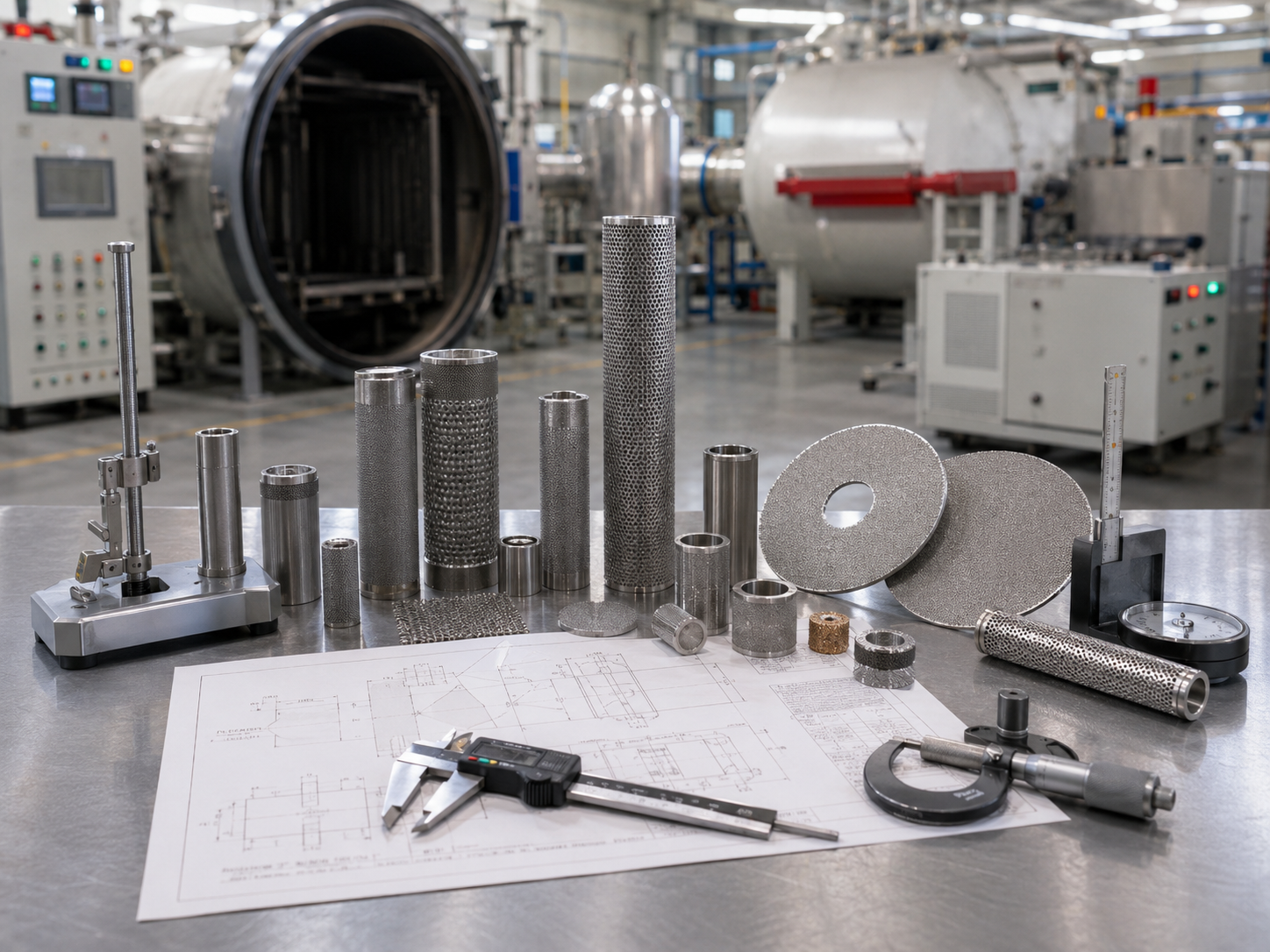
Drawing, dimensional and replacement-part review for custom porous metal projects.
Request a Custom Sintered Bronze Filter Quote
Start with your drawing or the main specification groups below. Unknown dimensions or requirements can be marked “to confirm” during technical review.
Show the complete 15-field engineering checklist
Expand for the full requirements. Select and copy the text manually for an RFQ email or drawing package.
Project: New OEM / replacement / repeat order
Product form: Disc / tube / plug / threaded / other
Material or alloy: Bronze grade if known, otherwise to confirm
Filter dimensions: Disc OD and thickness; tube OD, ID and length
Connection: G / NPT / metric or other thread and mating geometry
Porosity or filtration grade: Define test basis if retention is critical
Working medium and contaminants:
Target operating flow and flow direction:
Allowable clean-element differential pressure, if critical:
System line pressure, normal and maximum:
Operating temperature, normal and maximum:
Installation constraints, housing clearance and seals:
Inspection, test, sampling or acceptance needs:
Trial quantity and estimated annual/repeat demand:
Drawing, part number, photographs or existing physical sample:
The RFQ form does not accept file attachments. Send drawings, old-part photographs or specification sheets separately to sales@industrialmetalfilters.com.
Related Bronze and Porous Metal Products
Compare bronze filter elements with related discs, tubes, pneumatic products and stainless steel porous filters.
Sintered Bronze Filters FAQ
Common engineering and purchasing questions when specifying custom porous bronze filters.
What is a sintered bronze filter?
A sintered bronze filter is a rigid porous metal component manufactured from bronze powder. Its interconnected pore structure allows gas or liquid to pass through the element.
What filtration range is available for sintered bronze filters?
Common inquiry grades include 10, 20, 30, 40, 60, 80 and 100 μm. Suitability for a specific bronze component depends on geometry, thickness, porous structure, working medium and the filtration test definition. A nominal grade does not guarantee absolute particle retention.
What shapes can sintered bronze filters be made in?
Product forms can include filter discs, porous tubes, cylinders, plugs, threaded elements and custom shapes according to drawings, samples and installation requirements.
Can METAVOX make threaded porous bronze filter elements?
Yes. Threaded components can be manufactured according to thread standard, dimensions, porous structure, flow requirements, operating conditions and quantity.
Are sintered bronze filters suitable for pneumatic systems?
Porous bronze components can be used for pneumatic filtration, venting and equipment protection. When the main function is compressed-air exhaust and noise reduction, see Sintered Bronze Pneumatic Mufflers .
What is the difference between a sintered bronze filter and a pneumatic muffler?
A sintered bronze filter is selected primarily for filtration, protection, venting or controlled flow. A pneumatic muffler is installed at a compressed-air exhaust point, where airflow, exhaust restriction and noise reduction are the main design requirements.
Does a micron rating define the pressure drop?
No. Pressure drop also depends on component thickness, exposed porous area, operating flow, working medium and finished geometry. Flow and allowable differential pressure should be specified when restriction is critical.
What is the difference between line pressure and differential pressure?
Line pressure describes the operating pressure of the pneumatic, gas or liquid system. Differential pressure is the pressure difference across the porous filter element. They are separate parameters.
Are bronze filters the same as stainless steel sintered filters?
No. Bronze and stainless steel differ in material properties, corrosion behavior, cleaning requirements and application suitability. Material should be selected according to actual working conditions.
Can you reproduce an existing porous bronze filter from a sample?
Replacement components can be evaluated from drawings, old-part photographs, dimensions, thread details, equipment information or physical samples before manufacturing feasibility is confirmed.
What information is needed for a quotation?
Begin with the product form, material, dimensions and connection, filtration requirement, service conditions and quantity. See the complete engineering RFQ checklist for details and send a drawing or sample when available.
Need Custom Sintered Bronze Filters?
Send your drawing or relevant operating requirements for a manufacturing feasibility review. Use the bronze filter RFQ checklist to prepare the relevant details before requesting a quotation.