Porous Metal Tubes Manufacturer
METAVOX manufactures custom porous metal tubes, sintered metal tubes, porous stainless steel tubes, sintered stainless steel tubes and bronze porous tube components for industrial filtration, gas distribution, diffusion, venting, flow control and OEM equipment applications.
Porous tube projects are specified by material, outer diameter, inner diameter, wall thickness, length, pore or filtration requirement, end connection, working medium, operating flow, allowable differential pressure, line pressure, temperature, quantity, drawing and sample requirements.
- Porous stainless steel, sintered metal and bronze porous tube options
- Custom OD, ID, wall thickness, length, pore structure and end connection
- Filtration, diffusion, venting, gas distribution and OEM porous components
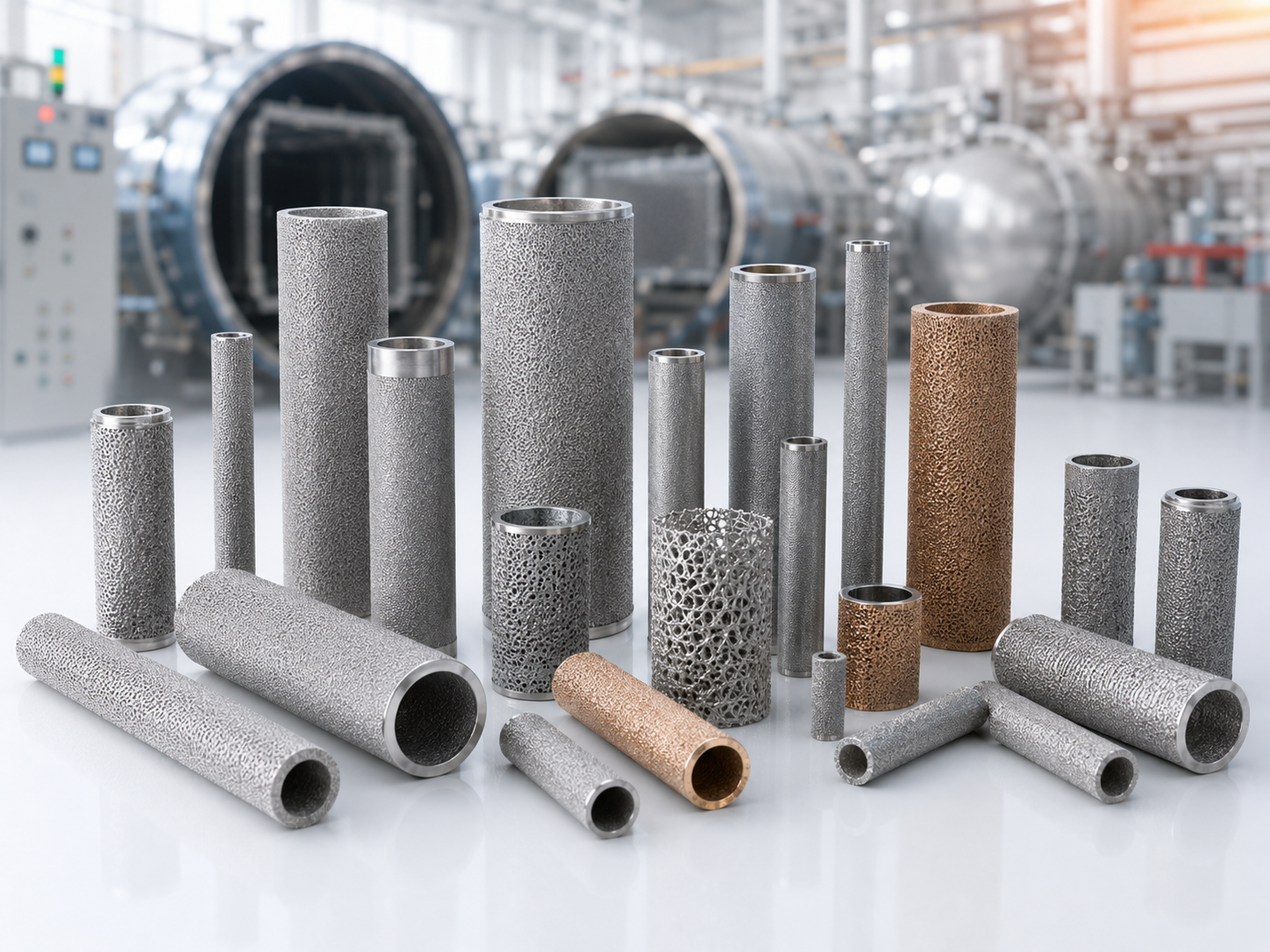
Custom Porous Metal Tubes for Filtration, Diffusion and Flow Control
Porous metal tubes are tubular components designed for controlled flow through a porous metal wall. They can perform filtration, diffusion, venting, flow distribution or equipment-protection functions depending on the selected material and pore structure.
Porous Stainless Steel Tubes
Custom 304 and 316L porous stainless steel tubes for filtration, gas distribution, liquid flow control and industrial equipment protection.
Sintered Metal Tubes
Rigid sintered metal tube structures with interconnected pores, specified according to working medium, flow, filtration requirement, pressure and installation conditions.
Bronze Porous Tubes
Powder-sintered bronze tubes for air, gas, oil, pneumatic, venting and compact flow-control applications where bronze is compatible with the process medium.
Thick-Wall Porous Tubes
Porous tubes with different wall thicknesses can be manufactured where mechanical strength, porous path length, diffusion area or flow resistance must be considered.
Open-End & Closed-End Filter Tubes
Open-ended tubes, closed-end porous cylinders and tubular filter components can be integrated into housings, test equipment and OEM filtration assemblies.
Custom Porous Tube Components
Special porous tube components can be manufactured according to drawing, sample, installation structure, end design and operating requirements.
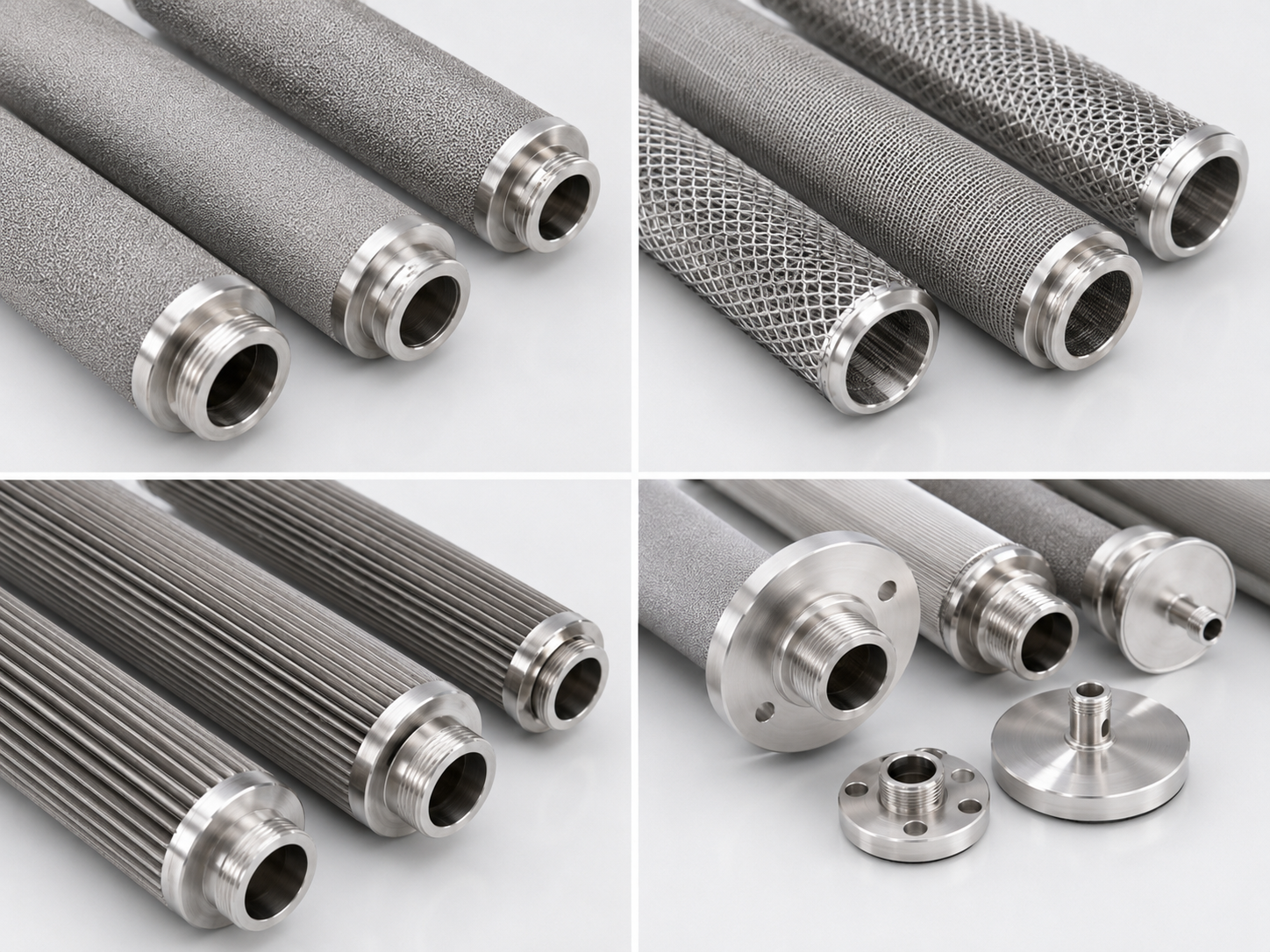
OD, ID, Wall Thickness, Length and Pore Structure
A porous metal tube should not be specified by length alone. Important dimensions include outer diameter, inner diameter, wall thickness, overall or effective porous length, tube-end design and any welded, threaded or retained connections.
Pore structure and wall thickness also influence flow, differential pressure, filtration behavior, gas-distribution performance and cleaning. When the tube is installed in a working system, provide the medium, operating flow, pressure and temperature together with the dimensions.
- Custom outer diameter, inner diameter, wall thickness and length
- Porous stainless steel, bronze and other qualified powder-sintered metal options
- Open-end, closed-end, cut-to-length, welded and custom tube structures
- Operating flow and allowable clean-tube differential pressure for restriction-sensitive systems
- Drawing and sample review for replacement components
Radial wall = (OD − ID) ÷ 2
Active porous length
Specify porous length separately from overall length.
How to Specify OD, ID, Wall Thickness and Active Porous Length
For a straight tube with a uniform circular wall, the radial wall thickness is calculated from the outside and inside diameters:
Specify both the overall tube length and the active porous length. A welded fitting, solid end cap or mounting section can reduce the porous section available for flow.
Nominal outer cylindrical area can be estimated as π × OD × active porous length. This geometric area is not the effective open-pore area and does not, by itself, establish flow capacity or pressure drop.
For an installed component, include the mating dimensions, flow direction and sealing arrangement. For an existing part, a drawing or measured sample is the most reliable starting point.
Porous Metal Tube Size Options for Custom RFQs
Start from a familiar tubular configuration or send an existing part drawing. The dimensions below are examples of industrial inquiry configurations—not a stock list. Each design is reviewed for material, pore structure, tooling, dimensional tolerances and service conditions before a quotation is confirmed.
316L Stainless Steel Tubes
For corrosion-sensitive gas or liquid systems. Ask about powder-sintered tube bodies, closed ends and connection fittings.
304 Stainless Steel Tubes
For compatible general-purpose services. Specify medium, cleaning chemistry and temperature when selecting a material.
Porous Bronze Tubes
For compatible air, gas, oil and compact equipment duties. Specify dimensions and functional pore requirements rather than assuming stainless grades are interchangeable.
Swipe the table sideways to view all dimensions.
| Example tube inquiry | Outer diameter (OD) | Wall thickness | Overall length | Use as a starting point |
|---|---|---|---|---|
| Compact porous tube | 20 mm | 2 mm | 100 mm | Small housings, venting and equipment components |
| Short filtration tube | 30 mm | 2 mm | 250 mm | Liquid/gas filtration and replacement element inquiries |
| Medium porous tube | 50 mm | 2.5 mm | 500 mm | Process flow or gas-distribution inquiries |
| Long tubular element | 75 mm | 3 mm | 600 mm | Larger surface-area or OEM assembly inquiries |
| Nonstandard / drawing-based | Specify OD | Specify wall / ID | Specify total and porous length | Welded, threaded, closed-end, special fittings or replacement tubes |
Dimension convention: examples are OD × nominal radial wall thickness × overall length. For a straight, uniform tube, the nominal inside diameter is OD − (2 × wall thickness). End caps, seals, joints and the active porous length must be defined separately. The example configurations are for specifying an RFQ; they do not indicate guaranteed production sizes or immediate stock.
Nominal Media Grades and Tube End Options
- Common stainless powder media requests: 0.5, 2, 5, 10, 20, 40 or 100 μm nominal grade
- Alternative grades: evaluate finer or intermediate requests case by case
- Tube ends: open/open, open/closed, closed-end cylinder or a fitted end cap
- Connections: plain ends, weld-on fittings, threaded interfaces or custom mounting details
- Filtration duty: state particle retention and test requirements separately from a nominal media grade
- Flow-critical duty: specify working medium, temperature, required flow and maximum initial pressure drop
A nominal grade describes a media selection; it does not by itself certify absolute particle removal. Final grade, dimensional tolerance, performance and inspection requirements must be confirmed for the selected tube construction.
Porous Metal Tube Engineering Selection
Finished tube performance depends on the porous material, pore structure, wall thickness, exposed surface area, operating flow, working medium and installation geometry.
Nominal Grade Requests: 0.5–100 μm Examples
Industrial powder-sintered media can be specified using grades such as 0.5, 2, 5, 10, 20, 40 or 100 μm. Suitable grades for a finished tube depend on material, tube geometry and the required filtration or flow duty. Nominal media grades are not absolute retention guarantees.
Custom OD, ID, Wall Thickness & Length
Tubular geometry is specified according to available installation space, required porous area, mechanical support and operating conditions.
Flow and ΔP Must Be Specified Together
When flow restriction matters, provide the required gas or liquid flow and the maximum acceptable clean-tube differential pressure.
| Technical Item | Selection Basis | Engineering Consideration |
|---|---|---|
| Primary Structure | Rigid porous tubular metal component | Confirm whether the application requires filtration, diffusion, venting or another controlled-flow function. |
| Material | Stainless steel, bronze and other qualified porous-metal options | Select according to medium compatibility, corrosion, temperature and mechanical requirements. |
| Powder-Sintered Filtration Range | Nominal grade requests, e.g. 0.5, 2, 5, 10, 20, 40 or 100 μm | The usable range for a specific tube depends on material, wall thickness, geometry and manufacturing configuration. |
| Outer Diameter | Custom by drawing | OD determines installation fit and available outer porous surface area. |
| Inner Diameter | Custom by drawing | ID should be specified together with OD to define wall thickness and internal flow passage. |
| Wall Thickness | Application-specific | Wall thickness affects porous path length, mechanical strength and flow resistance. |
| Length | Custom overall and effective porous length | Separate the total component length from the actual exposed porous length where necessary. |
| End Construction | Open end, closed end, welded end, threaded connection or custom interface | Provide mating dimensions and sealing details for installation. |
| Filtration / Pore Requirement | Micron grade, pore requirement or defined functional target | State whether the value is a filtration grade, pore specification or required particle-removal performance. |
| Operating Flow | Gas or liquid flow rate | Flow should be specified whenever restriction, throughput or diffusion performance is important. |
| Clean-Tube Differential Pressure | Maximum acceptable initial ΔP | Evaluate at the required operating flow and working medium. |
| System / Line Pressure | Operating process pressure | Line pressure is not the same as differential pressure through the porous wall. |
| Working Medium | Air, gas, liquid, oil and compatible industrial process media | Chemistry, viscosity, moisture, oil mist and contamination can influence selection. |
| Temperature | Confirm according to material and finished assembly | Temperature capability should be confirmed for the actual tube, joints and connections. |
| Flow Direction | Inside-to-outside, outside-to-inside or distribution through the wall | Specify the intended flow path when it affects support, cleaning or installation. |
| Cleaning / Reuse | Application-specific | Cleaning method depends on material, pore structure, contaminants and finished component design. |
| Quantity | Prototype, qualification or production quantity | Quantity affects manufacturing method, tooling and quotation. |
Wall Thickness, Porous Area and Flow Determine Tube Restriction
Two porous metal tubes with the same micron grade can have very different flow resistance if their wall thickness, diameter, porous length or operating flow are different.
For filtration applications, specify the required flow and allowable clean-element differential pressure together with the filtration requirement.
For gas distribution or diffusion applications, also provide the gas flow, operating liquid or process condition, installation depth where relevant and available supply pressure.
Micron Grade, Particle Retention and Pore Size Are Not Interchangeable
A stated micron grade can describe a media grade or a filtration rating, depending on the supplier and test method. It should not be interpreted as a guaranteed absolute particle-removal efficiency without a defined test criterion. If your system requires a specified retention efficiency, state the particle size, required efficiency and acceptance method.
Flow and pressure-drop requirements should be evaluated for the finished porous tube at the actual medium and operating flow. Media-family figures alone do not predict an assembled tube’s performance.
Where Porous Metal Tubes Are Used
Porous metal tubes are used when equipment requires controlled flow through a rigid tubular metal wall for filtration, diffusion, venting or equipment protection.
Gas Distribution and Diffusion
Porous tubes can distribute gas through the tube wall in industrial gas-liquid and process applications. For purpose-built gas-distribution elements, see Sintered Metal Spargers .
Liquid and Oil Filtration
Sintered metal tubes can function as tubular filter elements for liquid filtration, oil filtration, process filtration and equipment protection.
Gas & Air Filtration
Porous stainless steel and bronze tubes can be used for process gas, compressed air, gas filtration and equipment protection.
Venting & Pressure Equalization
Porous tube components can support controlled venting, pressure equalization and airflow management in enclosed equipment.
OEM Equipment Components
Custom porous tubes can be integrated into pumps, valves, sensors, test equipment, process systems and special industrial assemblies.
Replacement Tube Projects
Existing porous tube components can be evaluated from old-part photographs, dimensions, drawings, equipment information or physical samples.
Porous Filter Tubes, Gas-Distribution Tubes and Metal Spargers
Tubular porous metal components can perform different functions. Selection should start with the required process duty, flow direction and performance requirement.
Porous Metal Filter Tubes
Choose a porous filter tube when the main requirement is particle filtration, equipment protection or controlled passage of gas or liquid through the tube wall.
Porous Gas-Distribution Tubes
Tubular porous components can distribute gas through their surface when gas flow, available pressure and process conditions are properly specified.
Sintered Metal Spargers
For dedicated sparging, aeration, gas-liquid contact or process-gas distribution, see the Sintered Metal Spargers product range.
| Primary Duty | Design Priority | Information Needed Before Selection |
|---|---|---|
| Liquid or gas particle filtration | Retention target, media compatibility, allowable clean-element ΔP and flow path | Target particle size or specified filtration rating, required flow, medium, operating pressure and cleaning conditions |
| Gas distribution or diffusion | Gas flow through the porous wall, available driving pressure and process conditions | Gas and surrounding medium, flow rate, liquid depth where relevant, pressure available at the tube and tube geometry |
| Venting or pressure equalization | Required flow restriction, environment, ingress protection needs and installation fit | Air or gas properties, operating duty, allowable restriction, connection and contamination exposure |
| Replacement or OEM tube | Mechanical fit, end construction, material and matching functional performance | Original drawing or sample, mating dimensions, operating conditions, initial order and estimated annual demand |
Porous Metal Tubes vs Ordinary Steel Tubes
A porous metal tube is manufactured to allow controlled flow through its wall. Ordinary seamless tube, standard pipe and decorative perforated tube do not provide the same controlled porous structure.
Controlled Porous Wall
The working surface is the porous metal wall. Pore structure, wall thickness and active surface area influence flow and filtration behavior.
Application-Specific Geometry
OD, ID, wall thickness, porous length and end construction are matched to the equipment and required process duty.
Manufacturing Feasibility
Tube size, wall thickness, material, pore requirement and connection design are evaluated together before custom production.
Request a Quote for Porous Metal Tubes
To quote accurately, please provide material, outer diameter, inner diameter, wall thickness, tube length, effective porous length, pore or filtration requirement, open-end or closed-end design, connection details, working medium, operating flow, allowable clean-tube differential pressure if critical, line pressure, temperature, quantity and drawing details.
For gas-distribution applications, also provide the required gas flow, process conditions, installation depth where relevant and available supply pressure.
The RFQ form does not upload attachments. If you have drawings, sample photos or technical files, email them to sales@industrialmetalfilters.com .
Related Porous and Sintered Metal Filter Products
Compare porous metal tubes with related filter forms, materials and gas-distribution components.
Porous Metal Tube Drawing and Quotation Checklist
A clear set of dimensions and process conditions helps determine manufacturing feasibility without assuming that one nominal pore grade or standard size fits every application.
Tube and Connection Details
- Preferred material: 304, 316L or compatible bronze; confirm suitability for the working medium
- Outer diameter (OD), inner diameter (ID), radial wall thickness and their dimensional tolerances where critical
- Overall length, exposed porous length and required end construction
- Open or closed end, fitting/thread/weld interface and seal arrangement, if applicable
- 2D drawing, 3D file, photograph or dimensions from an existing part
Process and Purchasing Details
- Purpose: particle filtration, diffusion, venting or another controlled-flow duty
- Pore grade or particle-retention target and any required acceptance criteria
- Liquid or gas medium, target flow, flow direction and allowable clean-tube pressure drop
- Line pressure, operating temperature and relevant chemical or cleaning exposure
- Prototype quantity, first production order and estimated repeat or annual usage
Useful Format for a Tube Inquiry
Send a drawing, measured sample or application description with the quantity required.
Material, porous structure, end design and performance requirements are evaluated for the proposed tube.
Available construction, testing requirements, sample needs and batch details are clarified before quotation.
For an overview of how custom metal filter structures and drawings are reviewed, see our factory capabilities.
Porous Metal Tubes FAQ
Common engineering and purchasing questions when specifying custom porous metal tubes.
What information is needed to quote porous metal tubes?
Please provide material, outer diameter, inner diameter, wall thickness, overall and porous length, pore or filtration requirement, end construction, working medium, operating flow, allowable pressure drop if critical, line pressure, temperature, quantity and drawings if available.
Can METAVOX manufacture porous metal tubes by drawing?
Yes. Custom tube components can be evaluated from drawings, sample photographs, dimensions, material, pore structure, connections and working conditions before manufacturing feasibility is confirmed.
What is the difference between porous metal tubes and ordinary steel tubes?
Porous metal tubes have a controlled porous wall for filtration, diffusion, venting or flow distribution. Ordinary seamless steel tubes are not designed for controlled flow through the tube wall.
Can porous metal tubes be made from stainless steel or bronze?
Yes. Stainless steel and bronze porous tube structures can be selected according to working medium, corrosion, temperature, geometry and application requirements.
What filtration range is available for powder-sintered porous tubes?
Typical powder-sintered media inquiry grades include 0.5, 2, 5, 10, 20, 40 and 100 μm. These are examples for discussing the target media grade, not guaranteed stock or an absolute particle-retention rating. Confirm the media, dimensions, working conditions and required test criteria for the finished tube.
Why are OD, ID and wall thickness all required?
OD and ID determine the tube fit and internal passage, while half their difference gives the radial wall thickness for a uniform circular tube. Wall thickness affects mechanical strength, porous path length and flow resistance.
Does micron rating determine the pressure drop?
No. Pressure drop also depends on wall thickness, porous surface area, operating flow, working medium and pore structure. Flow and allowable ΔP should be specified together when restriction is important.
What is the difference between line pressure and differential pressure?
Line pressure is the operating pressure of the system. Differential pressure is the pressure difference across the porous tube wall. They are separate engineering parameters.
What is the difference between a porous metal tube and a sintered metal sparger?
A porous metal tube describes the tubular porous component itself and may be used for filtration, venting, diffusion or flow control. A sintered metal sparger is selected specifically for gas distribution or gas-liquid contact, where gas flow, process conditions and available pressure are key design inputs.
Can you reproduce an existing porous metal tube from a sample?
Replacement tube projects can be evaluated from drawings, old-part photographs, measurements, equipment information or physical samples before manufacturing feasibility is confirmed.
Need Custom Porous Metal Tubes?
Send your drawing, sample photograph, material, OD, ID, wall thickness, length, pore or filtration requirement, operating flow, allowable pressure drop, first-order quantity, expected repeat demand where available, and working conditions. METAVOX will review manufacturing feasibility and provide a quotation.