Sintered Metal Filters Manufacturer
METAVOX manufactures custom sintered metal filters and porous metal filter components for industrial gas, liquid, oil, chemical, pneumatic and OEM filtration applications.
Available constructions include powder-sintered porous metal, sintered wire mesh and metal fiber media, with finished products made as discs, tubes, cartridges, plates, cylindrical elements and custom components. Selection is based on filtration requirements, dimensions, working medium, flow, differential pressure, line pressure, temperature, connection and installation conditions.
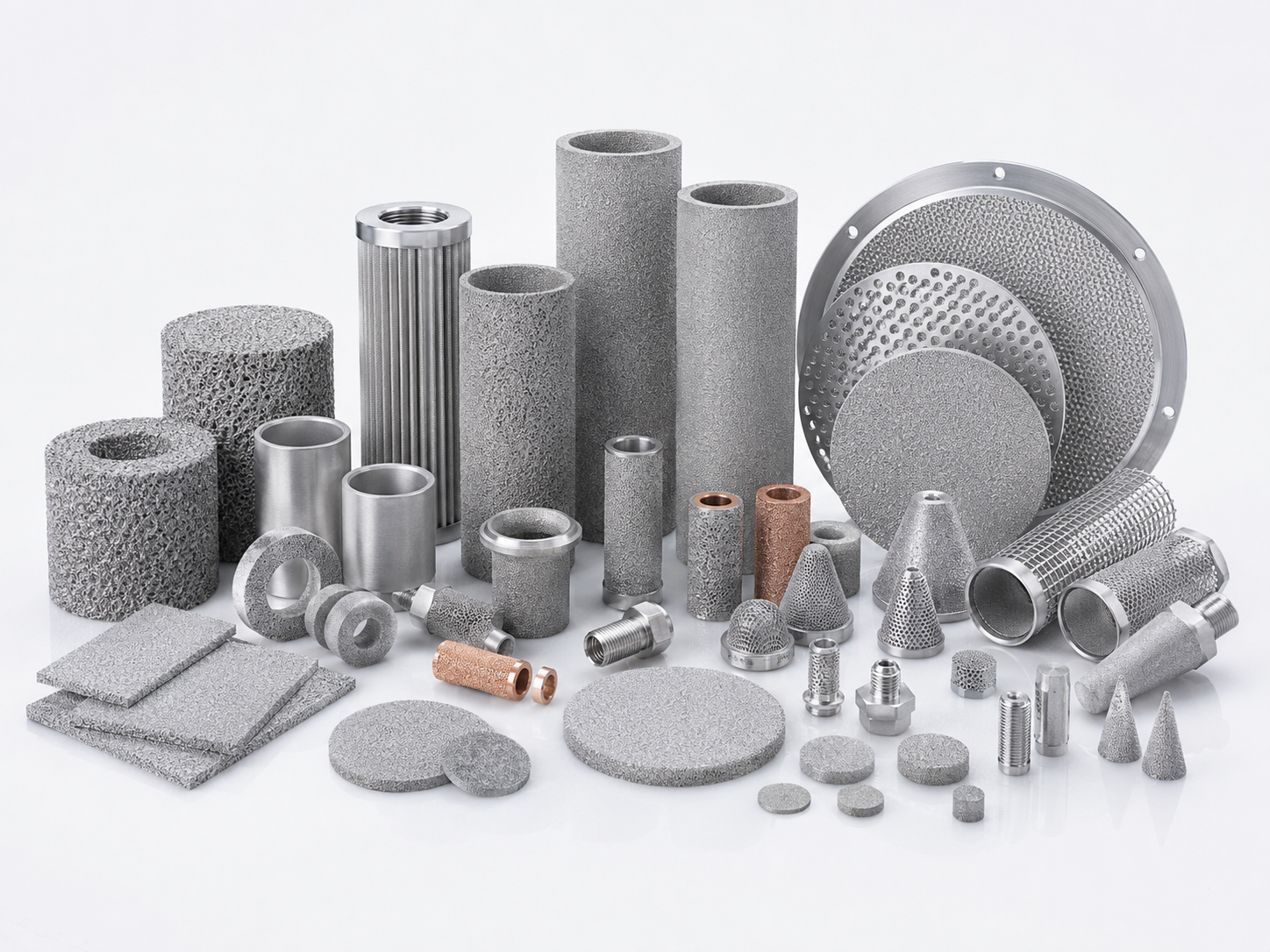
Sintered Metal Filters by Product Form and Material
Choose the product form or material that best matches the installation and operating requirements. For custom replacements or special geometries, drawings and samples can be reviewed before quotation.
Sintered Metal Filter Elements
Porous metal filter elements, tubes, discs and custom sintered components for industrial filtration and controlled-flow applications.
Sintered Metal Filter Discs
Round and washer-shaped filter discs made according to material, diameter, thickness, center hole and filtration requirement.
Sintered Metal Filter Cartridges
Rigid porous metal cartridges manufactured according to diameter, length, filtration requirement, connection and working conditions.
Sintered Metal Filter Plates
Flat porous metal plates and sheet-type components made by length, width, thickness, material and drawing.
Porous Metal Tubes
Porous metal tubes manufactured by OD, ID, wall thickness, effective length and flow-through-wall requirements.
Sintered Bronze Filters
Porous bronze discs, tubes, plugs and threaded components for pneumatic, gas, oil and compact filtration applications.
Sintered Stainless Steel Filters
Stainless steel porous filters for industrial gas, liquid, chemical and process filtration requirements.
Sintered Metal Spargers
Porous metal elements for gas distribution, diffusion and gas-liquid contact applications.
Custom Metal Filter Elements
Drawing-based replacements, sample reproduction, special equipment components and custom OEM filter geometries.
Choose the Sintered Metal Filter Structure for the Application
Powder-sintered metal, sintered wire mesh and metal fiber felt are all used in industrial metal filtration, but each structure has different flow, mechanical and filtration characteristics.
Powder-Sintered Metal Filters
Metal powder is sintered into a rigid interconnected porous structure. Available product forms include discs, cartridges, plates, cups, caps and custom porous components.
Stainless steel, bronze and titanium powder-sintered options can be selected according to material compatibility, filtration grade and component geometry.
Sintered Wire Mesh Filters
Multiple layers of woven stainless steel mesh are bonded by sintering to provide controlled filtration, mechanical support and cleanability.
Standard five-layer 316L sintered mesh is available in filtration grades from approximately 1 to 100 μm.
Metal Fiber Felt Filters
Sintered metal fibers form a highly porous filtration medium suitable for pleated construction, high dirt-holding capacity and applications requiring a larger effective filtration area.
Stainless steel fiber felt is available in multiple media grades, while FeCrAl fiber media can be considered for selected high-temperature applications.

Rigid Porous Metal Components for Industrial Filtration
Powder-sintered metal filters are manufactured by forming and sintering metal powder into a stable porous structure. Stainless steel, bronze and titanium options are available across multiple porous component shapes.
Finished flow and filtration performance depends on material, pore structure, component thickness, exposed porous area, working medium, operating flow and geometry. These factors should be evaluated together when pressure drop or filtration efficiency is important.
- Stainless steel, bronze and titanium powder-sintered options
- Discs, cartridges, plates, cups, caps and custom porous components
- Approx. 0.1–80 μm filtration grades across the powder-sintered product range
- Dimensions selected according to equipment and flow requirements
- Working medium, flow and differential pressure reviewed together
- Drawing and sample review available for custom manufacturing
Technical Information for Custom Sintered Metal Filters
Final specifications depend on filter construction, material, geometry and operating conditions. The values below identify the information normally required for product selection and quotation.
Approx. 0.1–80 μm
Powder-sintered filter grades are available across approximately 0.1 to 80 μm depending on material, product geometry and manufacturing configuration.
Approx. 1–100 μm
Standard five-layer 316L sintered wire mesh is available in multiple filtration grades from approximately 1 to 100 μm. Other constructions require separate confirmation.
High-Porosity Metal Media
Stainless steel sintered fiber felt is available in multiple media grades and provides high porosity for pleated and high-area filtration structures.
| Technical Item | Selection Basis | Engineering Consideration |
|---|---|---|
| Filter Construction | Powder-sintered metal, sintered wire mesh or metal fiber felt | Structure affects flow, strength, cleanability, porosity and available product geometry. |
| Material | Stainless steel, bronze, titanium, nickel or FeCrAl where applicable | Material selection depends on working medium, corrosion, temperature and mechanical requirements. |
| Filtration Requirement | Micron grade, pore requirement or defined particle-removal target | State whether the value represents a nominal grade, pore specification or required particle-removal efficiency. |
| Product Form | Disc, tube, cartridge, plate, cylinder or custom component | Geometry affects effective filtration area, installation and flow distribution. |
| Outer / Inner Diameter | Custom according to product and drawing | Diameter influences installation fit, porous area and mechanical design. |
| Length / Thickness | Application-specific | Porous path length influences resistance, strength and finished performance. |
| Connection | Threaded, welded, retained, flanged or custom assembly | Provide the mating interface, thread standard or housing drawing where available. |
| Operating Flow | Gas or liquid flow rate | Required when pressure drop, response time or flow capacity is important. |
| Clean-Filter Differential Pressure | Maximum acceptable initial ΔP | Particularly important for restriction-sensitive gas and liquid systems. |
| System / Line Pressure | Operating process pressure | Line pressure and differential pressure are different engineering parameters and should be specified separately. |
| Working Medium | Air, gas, liquid, oil and industrial process media | Chemistry, viscosity, contamination and operating condition affect material and media selection. |
| Temperature | Confirm according to material and construction | Temperature capability should be evaluated for the actual media, joints and finished assembly. |
| Particle Efficiency | Define when required | A micron or pore grade does not automatically establish removal efficiency at a specific particle size. |
| Cleaning / Reuse | Based on contamination and filter construction | Cleaning method depends on retained contaminants, material, media structure and finished component design. |
| Quantity | Prototype, qualification or production quantity | Quantity affects manufacturing method, setup cost and quotation. |
Micron Rating Alone Does Not Define Finished Filter Performance
A finer pore or filtration grade does not by itself determine pressure drop, flow capacity or particle-removal efficiency.
Finished performance depends on media structure, material, element thickness, exposed filtration area, flow rate, working medium, sealing and the agreed test method.
If filtration efficiency or pressure drop is critical, provide the operating flow, maximum acceptable clean-filter ΔP, particle size, required removal efficiency and test or acceptance standard.
Where Sintered Metal Filters Are Used
Sintered and porous metal filters are used where industrial equipment requires durable metal filtration, controlled flow, reusable media or custom component geometry.
Gas & Air Filtration
Porous metal elements can be used for process gas, compressed air, venting, gas protection and industrial air-filtration assemblies.
Liquid & Oil Filtration
Sintered metal elements can be manufactured for liquid filtration, oil filtration, process protection and equipment filtration.
Chemical & Process Filtration
Stainless steel porous components can be selected where corrosion resistance, cleaning and process conditions require a durable metal filter.
Pneumatic Components
Bronze and stainless porous elements can be used for pneumatic filtration, venting and equipment protection. For exhaust noise reduction, see Sintered Bronze Pneumatic Mufflers .
Gas Distribution & Sparging
For applications requiring gas distribution, diffusion or gas-liquid contact, see Sintered Metal Spargers .
OEM Equipment Protection
Custom porous metal filters can protect valves, regulators, pumps, sensors, nozzles and other industrial equipment.
Select by Shape, Material or Operating Function
Start with the part geometry, material or operating function that most closely matches the application. For replacement parts, drawings and samples can be reviewed before manufacturing feasibility is confirmed.
Round Filter Discs
Sintered Metal Filter Discs are selected by material, diameter, thickness, center hole, filtration requirement and operating conditions.
Rigid Filter Cartridges
Sintered Metal Filter Cartridges are manufactured according to cartridge diameter, length, filtration grade, connection and flow requirements.
Flat Plates & Sheets
Sintered Metal Filter Plates are suitable for flat porous components specified by length, width, thickness and drawing.
Porous Tubes
Porous Metal Tubes are specified by OD, ID, wall thickness, length, material and flow requirements.
Bronze Porous Components
Sintered Bronze Filters include porous bronze discs, tubes, plugs and threaded components for compact industrial applications.
Drawing-Based Custom Parts
Custom Metal Filter Elements can be developed for OEM equipment, sample reproduction, replacement components and special geometries.
Request a Quote for Sintered Metal Filters
For quotation, please provide product form, material, filter construction if known, outer diameter, inner diameter, length, thickness, filtration or pore requirement, connection, working medium, operating flow, maximum acceptable clean-filter differential pressure if critical, line pressure, temperature, quantity and drawing details.
If a specific particle-removal efficiency is required, also provide the particle size, target efficiency and test or acceptance method.
The RFQ form does not upload attachments. Send drawings, sample photos and specification sheets to sales@industrialmetalfilters.com .
Explore Sintered and Porous Metal Filter Products
Compare product forms, materials and filter constructions for different industrial filtration requirements.
Sintered Metal Filters FAQ
Common technical and purchasing questions when specifying custom sintered and porous metal filters.
What is a sintered metal filter?
A sintered metal filter is a porous metal filtration component manufactured using a sintering process. Depending on the construction, the porous medium may be formed from metal powder, bonded wire mesh or sintered metal fibers.
What types of sintered metal filter construction are available?
Common constructions include powder-sintered porous metal, multi-layer sintered wire mesh and sintered metal fiber felt. The best structure depends on filtration grade, flow requirement, pressure drop, strength, cleanability and finished product geometry.
What materials are available?
Material options depend on the filter construction. Powder-sintered products can include stainless steel, bronze and titanium. Sintered mesh commonly uses stainless steel, while metal fiber media can include stainless steel, nickel and FeCrAl for suitable applications.
What filtration range is available?
Filtration ranges vary by construction. Powder-sintered metal filters are available across approximately 0.1 to 80 μm depending on material and geometry. Standard five-layer sintered wire mesh is available in multiple grades from approximately 1 to 100 μm. Metal fiber felt uses its own construction-specific media grades.
What shapes can sintered metal filters be made in?
Product forms can include discs, cartridges, plates, sheets, tubes, cylinders, cups, caps and custom porous components. Final manufacturing feasibility depends on material, media structure, dimensions and operating requirements.
What is the difference between powder-sintered filters and sintered wire mesh filters?
Powder-sintered filters use a rigid porous structure formed from metal powder. Sintered wire mesh filters use bonded layers of woven metal mesh. Their flow characteristics, thickness, mechanical structure and filtration grades should be evaluated separately.
What is the difference between powder-sintered filters and metal fiber felt?
Metal fiber felt uses a porous network of metal fibers and provides high porosity, making it suitable for pleated structures and larger effective filtration areas. Powder-sintered filters use a more rigid porous powder-metal structure.
Does a micron rating define particle-removal efficiency?
No. A pore or micron specification does not automatically define particle-removal efficiency at a specific particle size. If efficiency is critical, provide the particle size, target removal percentage, operating flow and test method.
Why are flow and differential pressure important?
Finished pressure drop depends on media structure, thickness, effective filtration area, working medium and operating flow. For restriction-sensitive systems, provide the required flow and maximum acceptable clean-filter ΔP.
What is the difference between line pressure and differential pressure?
Line pressure is the operating pressure of the process system. Differential pressure is the pressure difference across the porous filter. They are separate engineering parameters.
Can METAVOX make custom sintered metal filters from drawings or samples?
Yes. Custom projects can be reviewed from drawings, sample photos, dimensions, equipment information or physical samples before manufacturing feasibility and quotation are confirmed.
What information is needed for a quotation?
Please provide product form, material, filter construction if known, dimensions, filtration requirement, connection, working medium, operating flow, allowable pressure drop if critical, line pressure, temperature, quantity and drawing or sample information.
Need Custom Sintered Metal Filters?
Send your drawing, sample photo, material, product geometry, filtration requirement, operating flow, allowable pressure drop, working conditions and quantity. METAVOX will review manufacturing feasibility and provide a quotation.