Sintered Metal Powder Filters for Custom Industrial Filtration
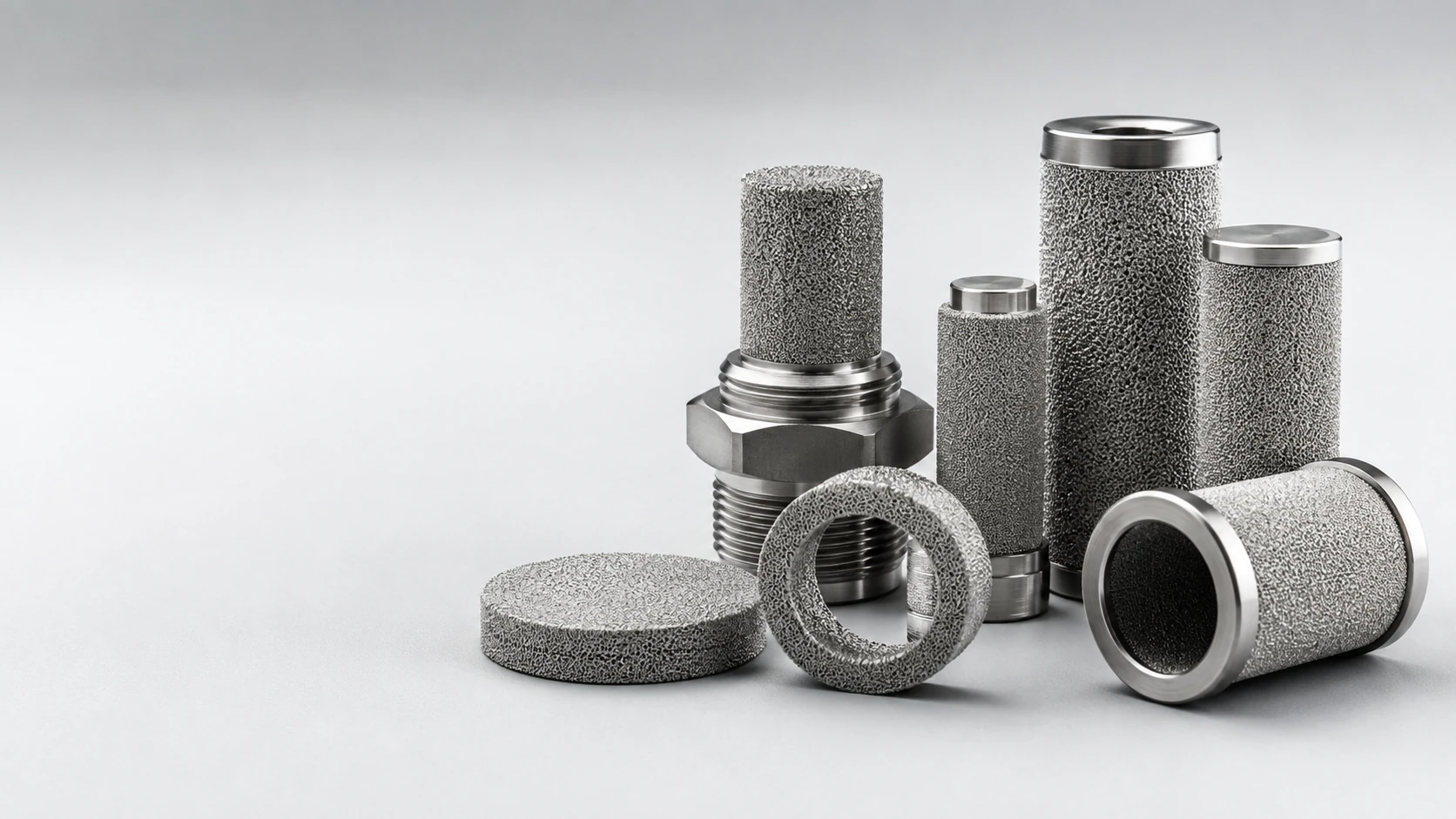
METAVOX manufactures custom sintered metal powder filters and rigid porous metal components for industrial gas, liquid, oil, chemical, pneumatic and OEM applications. Powder-sintered media can be produced as discs, tubes, cups, cylinders, cartridges and drawing-specific porous parts.
Discs, tubes, cups, cylinders, cartridges and drawing-specific parts
316L, 304, bronze, copper powder, titanium and project-specific materials
Rating, flow, medium, pressure, temperature, cleaning and geometry
What Makes a Powder-Sintered Filter Different?
A powder-sintered filter is formed from metal particles rather than woven wire or randomly laid fibers. During sintering, the particles bond at their contact points while open pathways remain through the body. This combination gives the finished part both structural rigidity and controlled permeability.
The manufacturing route is especially useful when the filter must be made as a compact three-dimensional component instead of a sheet-based medium. Closed-end tubes, thick discs, porous cups, bushings, plugs, small cylinders and special shapes can be produced as self-supporting porous parts, subject to material, tooling and dimensional feasibility.
Powder Filters by Shape and Installation Requirement
Porous Discs
Round and washer-shaped powder-sintered parts for compact filtration, restriction, protection and flow distribution.
Porous Tubes & Cylinders
Open-end or closed-end tubular structures for gas, liquid, venting, diffusion and filter element applications.
Porous Metal Cups
Cup-shaped porous components with an open mounting end and a closed porous body for compact filtration and flow-control assemblies.
Cartridges & Elements
Powder media can be integrated into cartridge, candle, threaded and custom filter element structures.
Bronze Porous Parts
Bronze and copper-powder components are commonly reviewed for compact pneumatic, gas, oil and flow-control duties.
Drawing-Specific Parts
Non-standard wall profiles, shoulders, holes, threads, fittings and mounting features can be reviewed from drawings or physical samples.
How Sintered Metal Powder Filters Are Made
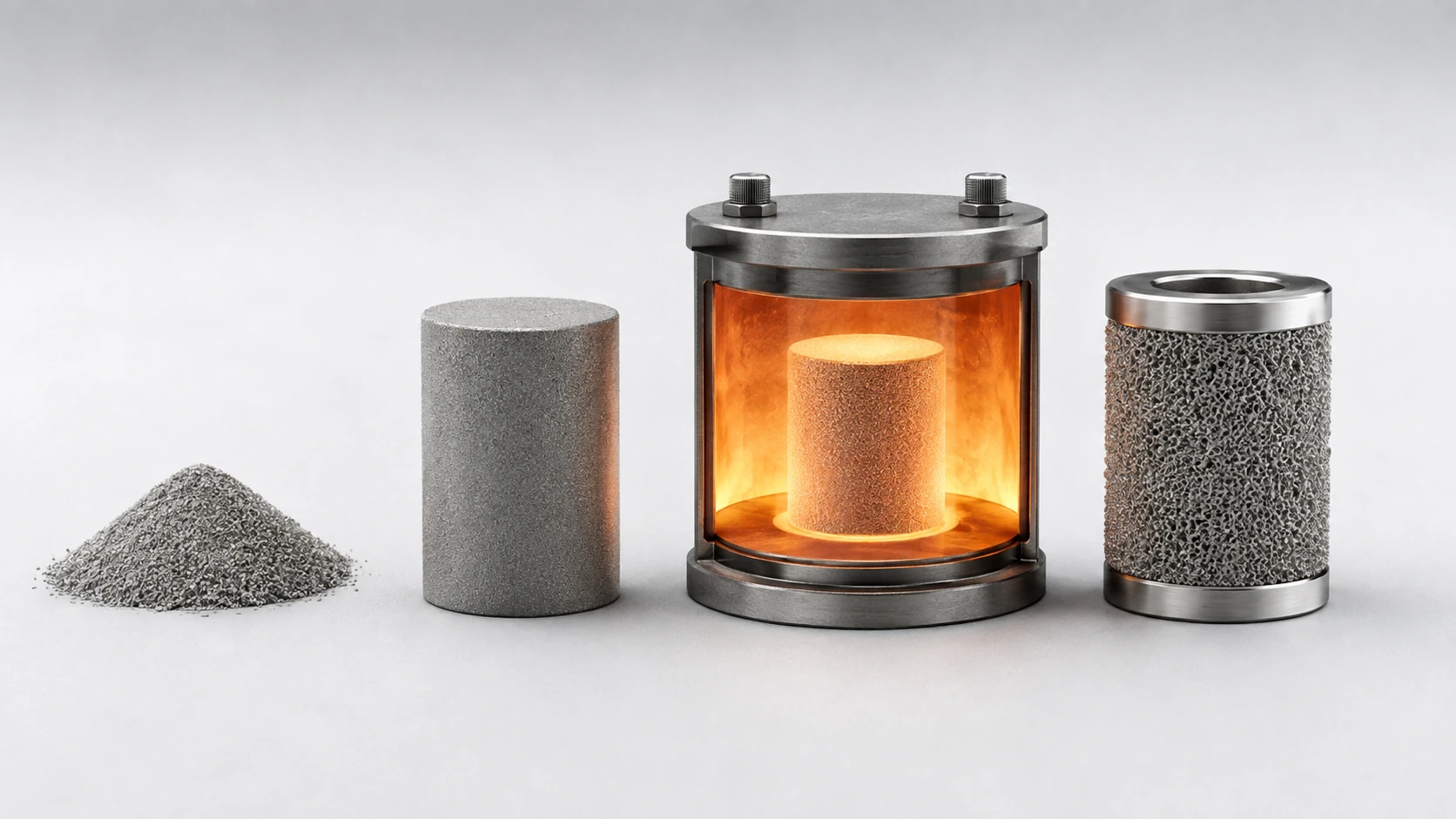
Powder metallurgy forms a metal part from powder and consolidates it by heating below the material’s full melting point. For porous filtration components, the process is controlled so that a connected pore network remains in the finished structure.
- Powder selection and grading: particle characteristics are chosen around material, pore structure and production requirements.
- Compaction or forming: powder is shaped into a green part using tooling or another suitable forming route.
- Sintering: controlled heating bonds the particles into a rigid porous body without fully melting the material.
- Secondary processing: machining, welding, fitting integration, cleaning or dimensional finishing may follow where the design requires it.
- Inspection: dimensions, appearance and project-specific filtration or flow requirements are reviewed against the agreed specification.
For general powder-metallurgy background, see the Metal Powder Industries Federation.
What to Specify Before Ordering a Sintered Powder Filter
| Selection factor | Why it matters | Useful RFQ information |
|---|---|---|
| Selection factorMaterial | Why it mattersControls corrosion behavior, temperature capability, compatibility and cost. | Useful RFQ information316L, 304, bronze, copper powder, titanium or required grade. |
| Selection factorFiltration requirement | Why it mattersDefines the target retention or pore requirement, but must be tied to a test basis and application. | Useful RFQ informationTarget particle size, nominal/absolute requirement if applicable, current filter reference. |
| Selection factorFlow and pressure drop | Why it mattersA fine or thick porous structure may restrict flow more than a coarse or larger-area design. | Useful RFQ informationGas/liquid, flow rate, viscosity if relevant, allowable clean pressure drop. |
| Selection factorDimensions | Why it mattersWall thickness and filtration area directly affect permeability, strength and fit. | Useful RFQ informationOD, ID, length, thickness, hole size, thread and tolerances. |
| Selection factorOperating conditions | Why it mattersPressure, temperature and chemical exposure affect both media and connection design. | Useful RFQ informationWorking pressure, differential pressure, temperature, medium and cycle. |
| Selection factorCleaning method | Why it mattersBackflushing, ultrasonic cleaning, solvent or thermal cleaning place different demands on the element. | Useful RFQ informationPlanned cleaning method, frequency and acceptable service recovery. |
Qualifying a Custom Powder-Sintered Filter Before Production
For drawing-specific parts, define how the finished filter will be accepted as well as how it will fit. A requested micron grade by itself does not establish particle-retention efficiency, flow capacity or allowable pressure drop. Identify the operating fluid, flow rate and temperature, and agree on any required retention or differential-pressure test conditions before confirming the media grade and wall thickness.
Drawing and Sample Review
Include outer and inner diameters, length, wall thickness, mounting or thread details, critical tolerances and required sealing surfaces. For a replacement part, provide an existing sample or annotated drawing. State whether a prototype or fit-up sample needs approval before batch production.
Inspection and Purchase Requirements
Specify the intended quantity, dimensional inspection points, agreed filtration or flow acceptance method and any documentation required by your purchasing process. If material traceability, an inspection record or a test report is mandatory, request confirmation of document availability during the RFQ review.
Powder vs Wire Mesh vs Metal Fiber Felt
Powder-sintered media is not automatically the best metal filter for every duty. It is a strong starting point for rigid, compact and seamless porous shapes. Sintered wire mesh is often preferred when a layered screen structure, surface release and aggressive cleaning are important. Metal fiber felt is often selected when high porosity, depth loading and large pleated filtration area are priorities.
Where Sintered Metal Powder Filters Are Used
Gas & Air
Particulate filtration, venting, diffusion, pneumatic protection and controlled gas passage.
Liquid & Oil
Process filtration, oil filtration, reusable equipment protection and compact filter assemblies.
Chemical Processing
Metal construction can be reviewed where chemical compatibility, cleanability and rigid pore structure are required.
Flow Distribution
Porous components can distribute gas or liquid through a defined metal surface when uniform flow is required.
OEM Protection
Custom porous parts can protect valves, nozzles, sensors, regulators and other equipment components.
Replacement Projects
Existing parts can be reviewed from drawings, photos, dimensions, material information and working conditions.
Sintered Metal Powder Filter Questions
What is a sintered metal powder filter?
It is a rigid porous metal component made by forming metal powder and sintering the particles together while preserving interconnected pores. Gas or liquid passes through those pores while the structure provides filtration, flow control or diffusion.
Is a powder filter the same as a sintered wire mesh filter?
No. Powder filters are made from metal particles. Sintered wire mesh filters are made from layered woven mesh bonded together by sintering. Their pore geometry, flow behavior, cleaning characteristics and available forms are different.
Can powder-sintered filters be cleaned and reused?
Many designs can be cleaned and reused, but the effective cleaning method depends on the contaminant, media grade, geometry, alloy and process. Cleaning suitability should be considered when the element is specified.
Can you manufacture a custom shape from a drawing?
Yes, drawing-specific powder-sintered parts can be reviewed for material, dimensions, tooling, pore requirement, secondary machining, connection design and quantity before feasibility is confirmed.
What information should I send for a quotation?
Send the material, drawing or dimensions, filtration requirement, working medium, flow if known, pressure, temperature, cleaning method and quantity. For replacement projects, photos and an existing sample are also useful.
Need a Custom Sintered Metal Powder Filter?
Send your drawing, sample photo, material, dimensions, filtration requirement, working medium, pressure, temperature and quantity. We will review the structure and manufacturing route before quotation.
Request a Factory Quote