Sintered Mesh Filter Cartridges Manufacturer
METAVOX manufactures custom sintered mesh filter cartridges, sintered wire mesh cartridges and stainless steel mesh cartridge elements for industrial gas, liquid, oil, chemical and process filtration.
Standard cartridge construction can use five-layer sintered stainless steel mesh, with cartridge dimensions, filtration grade, end connection, support structure, operating flow, differential pressure, working medium and cleaning requirements selected for the application.

Custom Sintered Wire Mesh Filter Cartridges
Sintered mesh cartridges combine a layered stainless steel filtration medium with a cylindrical cartridge structure. Dimensions and connections can be matched to new equipment or replacement requirements.
Five-Layer Sintered Mesh Cartridges
Standard five-layer sintered stainless steel mesh provides a bonded, mechanically supported filtration structure for washable industrial cartridges.
Sintered Wire Mesh Cylinder Cartridges
Cylindrical cartridge bodies can be manufactured according to outer diameter, inner diameter, length, mesh grade and support requirements.
DOE, 222, 226 & Housing-Matched Cartridge Ends
End connections should match the actual housing receiver, seal and retaining method. DOE, 222 and 226 are different configurations; legacy 220 and custom connections require a drawing.
Threaded, Flanged & Fast Connections
Thread, flange, fast interface and custom connection structures can be evaluated from drawings or existing samples.
Tie-Rod Cartridge Assemblies
Tie-rod and retained cartridge structures can be manufactured according to the housing and assembly requirements.
Custom Replacement Cartridges
Existing mesh cartridges can be evaluated from drawings, old-element photographs, dimensions, housing information or physical samples.
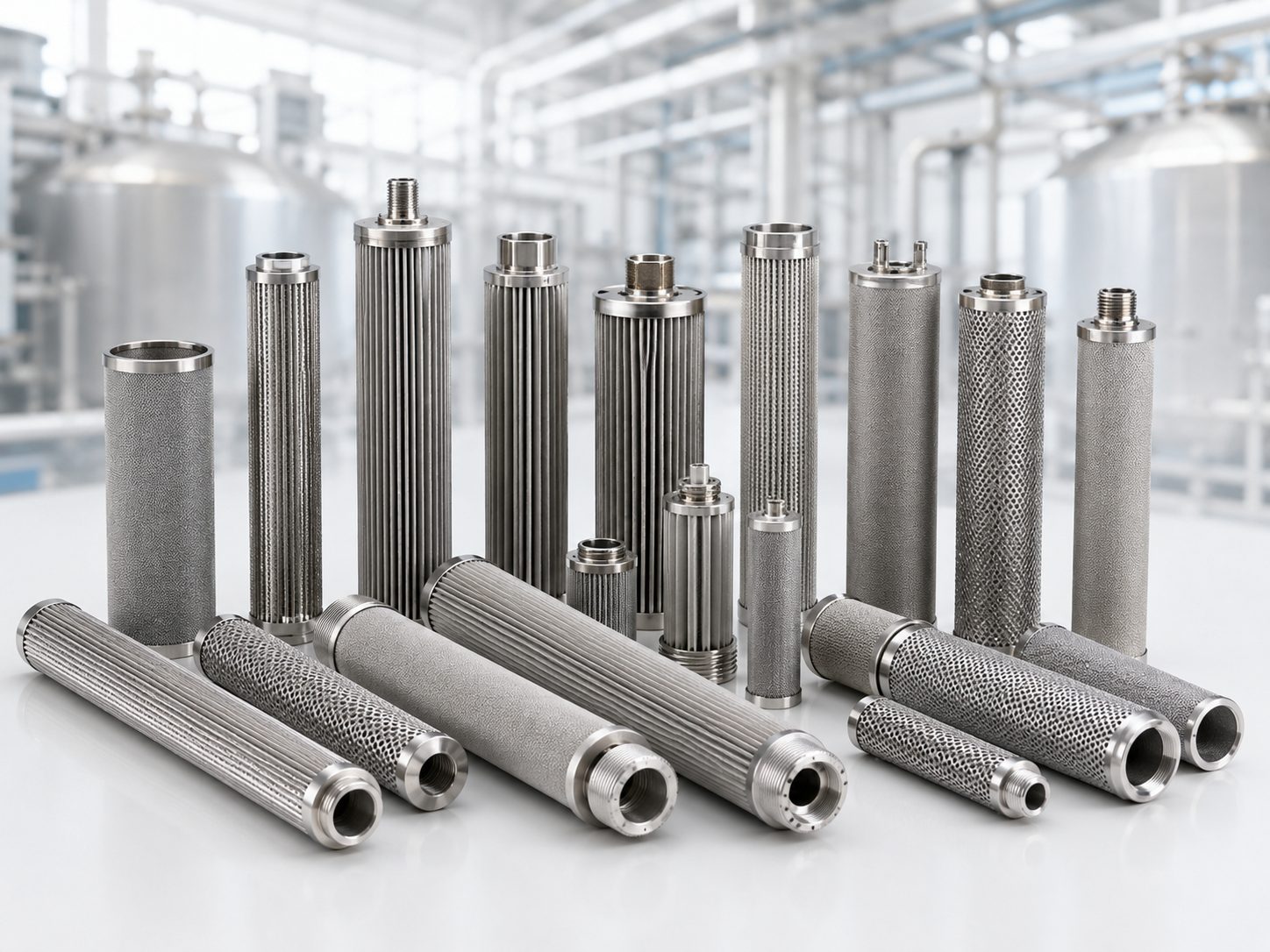
Five-Layer Sintered Stainless Steel Mesh Media
Standard five-layer sintered wire mesh is produced by bonding multiple layers of stainless steel mesh into a stable porous laminate.
For the standard five-layer configuration, 316L stainless steel and filtration grades from approximately 1 to 100 μm are available.
These values describe the standard mesh medium. Finished cartridge performance also depends on cartridge diameter, length, effective filtration area, support structure, operating flow, working medium and assembly design.
- Standard five-layer 316L sintered mesh construction
- Approx. 1–100 μm standard filtration grades
- Washable and reusable metal media
- Rigid layered construction with mechanical support
- Custom cartridge geometry and connection options
Sintered Mesh Filter Cartridge Sizes and Micron Grade Options
Start with an outside diameter and overall cartridge length, then confirm the housing connection, usable mesh length and operating conditions. The examples below are useful RFQ starting points for non-pleated sintered mesh cylinders, not fixed METAVOX stock sizes.
Swipe the table left or right to compare all specification fields.
| RFQ Configuration Example | Cartridge OD × Overall Length | Media Grade to Request | End / Mounting Detail | What to Confirm |
|---|---|---|---|---|
| Compact mesh cylinder | Ø25 × 125 mm | 5, 10 or 20 μm nominal request | Open / capped / custom | Core ID, active mesh length, installation clearance |
| Short industrial cartridge | Ø30 × 250 mm | 5, 10 or 40 μm nominal request | DOE or drawing-based | Gasket faces, retained length, support core |
| Mid-size cartridge | Ø50 × 500 mm | 10, 20 or 40 μm nominal request | Threaded, flange or custom | Thread standard, seal location, pressure direction |
| Replacement housing element | Ø65 × 750 mm | 5, 20 or 50 μm nominal request | 222 / 226 only if matching housing | Actual receiver/O-ring/locking geometry and overall seating length |
| Long OEM cartridge | Ø70 × 1,000 mm | 10, 40 or 100 μm nominal request | Flange, tie rod or engineered end | Collapse support, weld positions, handleability and fit |
Choosing the mesh construction
Five-layer 316L sintered wire mesh is a common starting construction for rigid, cleanable cylindrical cartridges. A reinforcement layer, support core or alternative mesh stack may be needed where the geometry or differential-pressure direction demands it.
Specify whether you need 5-layer, reinforced 6-layer or an existing material drawing to match. Final performance must be checked at the required flow and working fluid.
Geometric filter area
For a straight non-pleated cylindrical mesh element, approximate outside cylindrical area is A = π × OD × active mesh length. An Ø50 mm element with 200 mm of exposed mesh has about 31,400 mm² (0.0314 m²) of geometric area.
End bands, weld zones, internal supports and blocked surface reduce the exposed area. This calculation alone does not establish rated flow or pressure drop.
Sintered Mesh Filter Cartridge Selection Data
Cartridge specification should combine the mesh filtration grade with finished-element dimensions, connection, effective filtration area, flow and operating conditions.
316L Stainless Steel
Standard five-layer sintered wire mesh is available in 316L stainless steel. Other material requirements should be reviewed for the actual project.
Approx. 1–100 μm
Standard five-layer mesh is available in multiple filtration grades from approximately 1 to 100 μm.
222 / 220 / 226 & Custom
Connection designs can include 222, 220, 226, fast interface, thread, flange, tie rod and custom configurations.
| Technical Item | Typical / Available Basis | Engineering Consideration |
|---|---|---|
| Filter Media | Standard five-layer sintered stainless steel mesh | Confirm the actual mesh construction required for the cartridge. |
| Standard Material | 316L stainless steel for standard five-layer mesh | Material suitability depends on working medium, corrosion, temperature and cleaning requirements. |
| Filtration Grade | Approx. 1–100 μm standard five-layer mesh grades | A micron grade should not be treated as a guaranteed particle-removal efficiency. |
| Cartridge Outer Diameter | Custom by drawing or housing requirement | OD determines housing fit and available filtration area. |
| Cartridge Inner Diameter | Custom according to support and flow-path design | ID should be reviewed together with support-core geometry. |
| Cartridge Length | Custom by application | Length influences effective filtration area and housing fit. |
| Connections | 222, 220, 226, fast interface, thread, flange, tie rod or custom | Provide housing or mating-interface dimensions for custom replacements. |
| Flow Direction | Inside-to-outside or outside-to-inside according to design | Flow direction can influence support, contamination loading and cleaning. |
| Operating Flow | Gas or liquid flow rate | Required for finished-cartridge pressure-drop evaluation. |
| Clean-Filter Differential Pressure | Application-specific | Specify maximum acceptable initial ΔP at the required flow when restriction is important. |
| System / Line Pressure | Application-specific | System pressure and differential pressure across the cartridge are different parameters. |
| Working Medium | Air, gas, liquid, oil and compatible process media | Chemistry, viscosity, contamination and operating conditions affect material and cleaning selection. |
| Temperature | Confirm according to the complete cartridge assembly | Media, welds, seals, end fittings and housing conditions should all be considered. |
| Cleaning | Washable and reusable metal filtration structure | Cleaning method depends on retained contamination and complete cartridge design. |
| Quantity | Prototype, qualification or production quantity | Quantity influences manufacturing method, setup and quotation. |
Mesh Grade Does Not Define Finished Cartridge Pressure Drop
The filtration grade describes the selected sintered mesh medium, but finished pressure drop also depends on cartridge diameter, length, effective filtration area, support structure, flow direction, working medium and operating flow.
For restriction-sensitive gas or liquid systems, provide the required flow and maximum acceptable clean-cartridge differential pressure.
DOE, 222, 226, Threaded and Custom Cartridge End Connections
A mesh cartridge cannot be selected by micron grade alone. The end cap, O-rings, housing receiver and axial dimensions must match to prevent bypass and mechanical misfit.
The drawing distinguishes cartridge dimensions, active media, end caps and the internal support bore.
End-cap projection, active mesh length, seals and interface dimensions should be confirmed separately.
Confirm support-core bore (ID) and housing receiver geometry from the drawing.
Swipe sideways to compare connections on a phone.
| Connection Request | How It Seals / Fits | Buyer Must Supply | Critical Verification |
|---|---|---|---|
| DOE — Double Open End | Gaskets or seals compressed at both open ends by the housing assembly. | Overall length, gasket ID/OD/thickness, compression arrangement, tie-rod or retainer detail. | Axial compression, support and bypass path. |
| 222 O-ring interface | Housing receiver accepts matching 222-profile double O-ring connection. | Old-cartridge end photos, receiver drawing, closed-end style and seal compound. | O-ring groove, installed depth, retained length; do not assume interchangeable with 226. |
| 226 O-ring interface | Housing receiver and any locking/bayonet features must match the complete end-cap design. | Receiver diameter, locking-lug geometry, orientation, closed-end style and seals. | Installation lock and positive seal; not a direct 222 substitute. |
| 220 / legacy or custom interface | End details vary by equipment and supplier. | Complete mating drawing or a physical sample rather than just the number “220”. | Do not infer a universal dimensional standard from the label. |
| Threaded / flange / tie-rod | Mechanical retention and gasket/O-ring sealing defined by the equipment. | Thread pitch or flange drawing, bolt circle, gasket seat, OD/ID, flow direction. | Joint leakage, axial support, corrosion and service temperature. |
Industrial Applications for Sintered Mesh Filter Cartridges
Sintered wire mesh cartridges are used where a durable, cleanable and mechanically supported stainless steel filtration medium is required.
Gas Filtration
Sintered mesh cartridges can be used for industrial gas and process-air filtration where reusable stainless steel media is required.
Liquid Filtration
Layered metal mesh can support industrial liquid filtration where cleanability and rigid construction are important.
Oil & Process Fluids
Stainless steel mesh cartridges can be evaluated for compatible oil and process-fluid filtration applications.
Chemical Processing
316L sintered mesh can be considered where material compatibility and reusable metal filtration suit the process.
Filter Housings & Assemblies
Custom mesh cartridges can be designed around existing filter housings, equipment interfaces and defined installation envelopes.
Replacement Cartridge Projects
Existing mesh cartridges can be evaluated from drawings, dimensions, end connections, housing data, photographs or physical samples.
Sintered Mesh, Powder-Sintered and Pleated Metal Cartridges
These cartridge constructions may have similar external shapes, but their filter-media structures and operating characteristics are different.
Sintered Mesh Filter Cartridges
Choose sintered mesh when the application requires a layered stainless steel wire-mesh structure, defined mesh grades, mechanical support, cleanability and reusable metal filtration.
Sintered Metal Filter Cartridges
Powder-sintered cartridges use a rigid porous metal wall rather than layered stainless steel wire mesh.
Pleated Stainless Steel Filter Cartridges
Pleated cartridges use folded stainless steel mesh or metal fiber media to increase effective filtration area inside the cartridge envelope.
Flow Direction, Support Core and Clean-Filter Pressure Drop
Unlike a flat mesh sheet, an assembled cartridge has an internal flow path, seam welds, end caps and a housing interface. Those features affect actual usable area, pressure drop and cleaning suitability.
Inside-to-Outside or Outside-to-Inside?
Confirm the normal filtration direction and whether reverse-flow cleaning is expected. The support arrangement for one direction may be inadequate for the opposite differential pressure.
Housing Fit and Bypass Control
Specify usable cartridge length, end-seat depth, gasket position and any spring or tie-rod retention. Confirm the seal prevents fluid bypassing the mesh at the end caps.
Specify Flow and Differential Pressure Together
Request a clean-element pressure drop at a stated gas or liquid flow, temperature and fluid condition. System working pressure is not the same as differential pressure across the mesh wall.
For reusable cartridges
- Tell us the contaminant, cleaning fluid and acceptable cleaning process.
- Define any backflush direction and differential-pressure limit.
- Include weld, end-cap and support-core compatibility in the cleaning review.
For replacements and repeat orders
- Provide the old part number, housing drawing and photos of both ends.
- Record actual OD, length, support ID and seal seating dimensions.
- Agree sample acceptance before committing to repeat production quantities.
What to Check on a Finished Sintered Mesh Cartridge
Agree measurable acceptance requirements for the assembled cartridge rather than relying on the media micron label alone. Requested verification depends on the manufacturing route and confirmed inspection scope.
Dimensions and assembly
- Material grade and mesh laminate identification.
- Overall length, OD, ID, active mesh length and tolerances.
- End-cap geometry, weld/seam condition and support-core location.
- Gasket/O-ring compound, sealing seat and installation orientation.
Performance and documentation
- Nominal grade and, where required, a defined retention test method.
- Clean-element flow/ΔP test at an agreed test medium and conditions.
- Leak or integrity test for weld and end-seal paths where specified.
- Sample approval, traceability/inspection report scope and repeat-order criteria.
Drawing, Cartridge and Connection Review
Custom sintered mesh cartridge projects require both filtration-media review and mechanical-interface review before manufacturing feasibility and quotation are confirmed.

Industrial metal filter manufacturing capability for custom cartridges, mesh elements and other metal filter components.
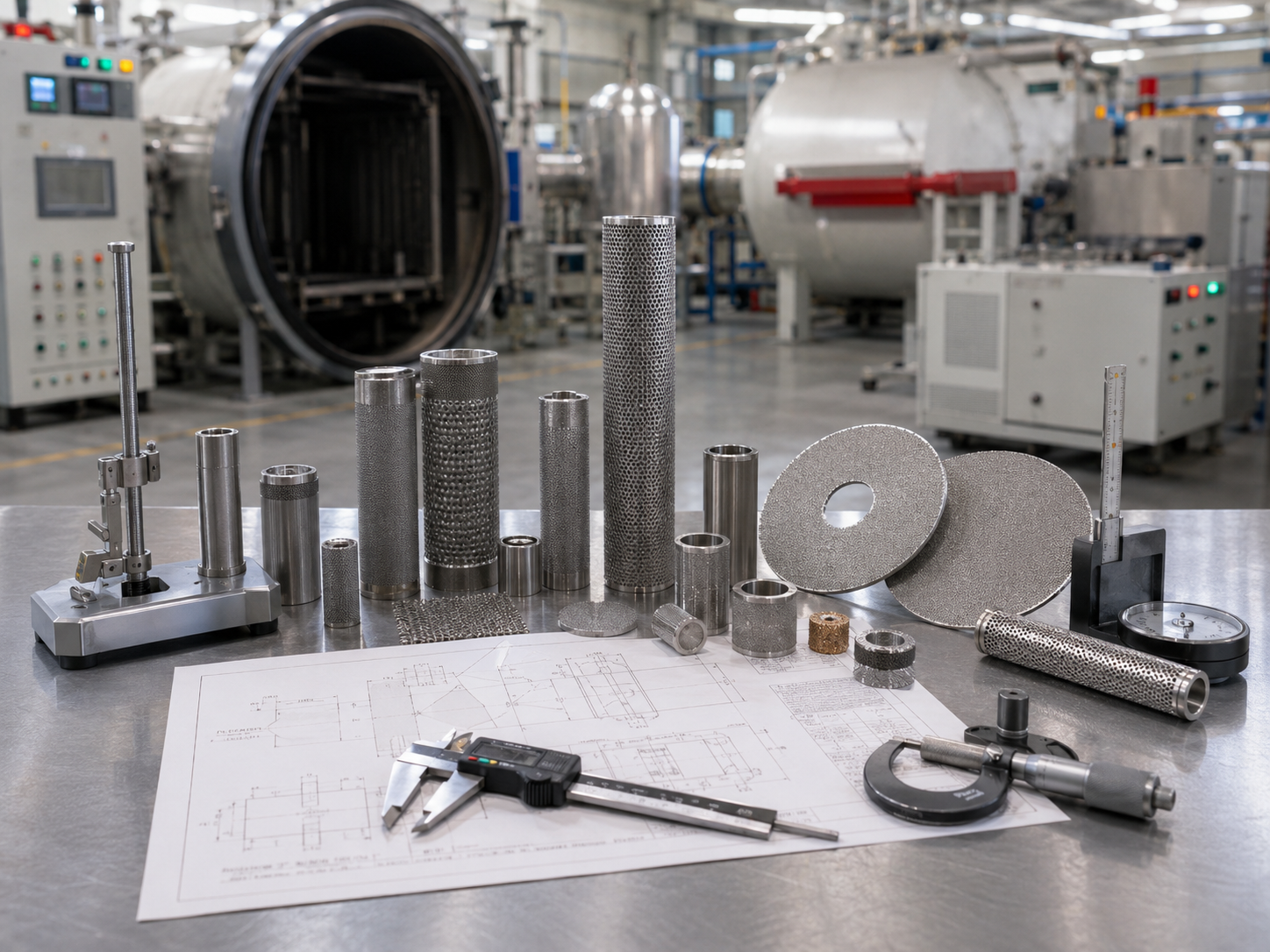
Drawing and dimensional review for custom and replacement industrial filter cartridge projects.
Request a Custom Sintered Mesh Filter Cartridge Quote
Start with a cartridge drawing or the six requirements below. Mark unknown details “to confirm” for feasibility review.
View the complete 15-field engineering checklist
Expand and manually select the full text when preparing a drawing package or email.
Product: Sintered mesh filter cartridge
Material: 316L / other (specify)
Mesh construction: 5-layer / reinforced / drawing
Nominal filtration grade: ___ μm
OD × ID × total length: ___ × ___ × ___ mm
Active porous length: ___ mm
End caps / interface: DOE / 222 / 226 / other
Gasket/O-ring & seal location: ___
Flow direction / backwash: ___
Working medium & temperature: ___
Operating flow & permitted clean ΔP: ___
System pressure / max differential pressure: ___
Required inspections / tests: ___
Sample quantity / annual quantity: ___
Drawing, housing data or old cartridge: attached
The RFQ form does not accept drawing attachments. Email CAD files, housing photos or sample drawings separately to sales@industrialmetalfilters.com.
How a custom cartridge is reviewed
1. Application and interface: review drawing, housing/retainer, working medium, operating flow and temperature.
2. Media and construction: check sintered mesh layer structure, active surface, support direction, seams and end fittings.
3. Sample and acceptance: agree critical dimensions and any required media, flow/ΔP or leak tests before prototype qualification.
4. Production quotation: confirm achievable configuration, quantity, documents, lead time and commercial terms for the actual order.
The RFQ form may not support file attachments. For CAD files or sample photographs, email the sales address using the button provided.
Related Mesh and Stainless Steel Filter Products
Compare sintered mesh cartridges with related mesh media, stainless steel cartridge structures and custom metal filter elements.
Sintered Wire Mesh Filters
Multi-layer stainless steel mesh sheets, discs, cylinders, cartridges and custom mesh components.
View Sintered Wire Mesh Filters →Sintered Metal Filter Cartridges
Rigid powder-sintered porous metal cartridges for industrial gas and liquid filtration.
View Sintered Metal Cartridges →Stainless Steel Filter Cartridges
Compare sintered, mesh, pleated and other stainless steel cartridge constructions.
View Stainless Steel Cartridges →Pleated Stainless Steel Filter Cartridges
Pleated metal cartridges using stainless steel mesh or metal fiber media for increased filtration area.
View Pleated Cartridges →Stainless Steel Filter Elements
Custom stainless steel discs, tubes, cartridges, mesh elements and industrial filtration assemblies.
View Stainless Steel Elements →Custom Metal Filter Elements
Non-standard cartridges, cylinders and custom metal filter components manufactured from drawings or samples.
View Custom Filter Elements →Sintered Mesh Filter Cartridges FAQ
Common technical and purchasing questions for custom sintered wire mesh cartridges.
What is a sintered mesh filter cartridge?
A sintered mesh filter cartridge uses bonded layers of stainless steel wire mesh as the filtration medium within a cylindrical cartridge structure.
What material is used for standard five-layer sintered mesh?
Standard five-layer sintered wire mesh is available in 316L stainless steel. Other material requirements should be confirmed for the specific cartridge project.
What filtration grades are available?
Referenced five-layer sintered mesh catalogues include nominal media grades across approximately 1 to 100 μm, depending on laminate selection. The appropriate grade depends on the application and required filtration performance.
What cartridge connections are available?
Connection designs can include 222, 220, 226, fast interface, thread, flange, tie rod and custom configurations according to the filter housing.
Can sintered mesh filter cartridges be cleaned and reused?
Sintered stainless steel mesh is suitable for washable and reusable filtration structures. The correct cleaning method depends on the contaminant, mesh grade and complete cartridge assembly.
Does micron rating determine cartridge pressure drop?
No. Pressure drop also depends on cartridge diameter, length, effective filtration area, support structure, working medium and operating flow.
Is system pressure the same as differential pressure across the cartridge?
No. System pressure is the operating pressure of the process. Differential pressure is the pressure difference across the filter cartridge as fluid flows through it.
What is the difference between a sintered mesh cartridge and a pleated cartridge?
A sintered mesh cartridge uses a rigid layered mesh structure. A pleated cartridge folds stainless steel mesh or metal fiber media to increase effective filtration area within the cartridge envelope.
What is the difference between a sintered mesh cartridge and a powder-sintered cartridge?
A sintered mesh cartridge uses bonded layers of woven stainless steel mesh. A powder-sintered cartridge uses a rigid porous wall formed from sintered metal powder.
Can METAVOX reproduce an existing mesh cartridge?
Replacement cartridges can be evaluated from drawings, dimensions, housing information, photographs or physical samples before manufacturing feasibility is confirmed.
Need Custom Sintered Mesh Filter Cartridges?
Send drawings, a sample cartridge or key service conditions for a feasibility review. Use the engineering RFQ checklist to prepare the detailed request.