Sintered Metal Filter Elements Manufacturer
METAVOX is an industrial metal filter manufacturer operating its own factory and production equipment for drawing-based sintered metal filter elements. Our factory manufactures custom sintered filter cartridges, porous tubes, filter discs, cylinders, candles and formed metal filtration components for industrial gas, liquid, oil, chemical, pneumatic and OEM equipment. We review the manufacturing route, material, dimensions, fit, service conditions and inspection requirements against each drawing before quotation.
Select the filter structure and material together with the required filtration performance, flow and allowable differential pressure. Cartridge geometry, end connections and sealing details are then reviewed against the installation or replacement part.
- Custom sintered filter elements, cartridges, tubes, discs, candles and special-shaped parts
- 316L, 304, bronze, copper powder, titanium and custom metal options by RFQ
- Factory quotation support for OEMs, filter companies, distributors and industrial buyers

Custom Sintered Metal Filter Elements for Industrial Filtration
Sintered metal filter elements are used when buyers need a rigid porous metal structure with stable filtration performance, mechanical strength, defined flow path and custom installation design.
Sintered Metal Filter Cartridges
Custom cartridges based on length, diameter, connection style, end cap, micron rating, flow requirement and working conditions.
Sintered Filter Tubes
Porous tube elements selected by OD, ID, wall thickness, exposed porous length and flow through the wall. Explore tube configurations →
Sintered Filter Discs
Round and washer-shaped porous elements selected by diameter, thickness, center hole and installation fit. For larger flat forms, compare sintered filter plates.
Sintered Filter Candles
Candle-style filter elements for industrial filtration systems, process filtration and custom filter housings.
Threaded Filter Elements
Threaded porous metal filter elements designed according to connection method, thread type, flow direction and installation space.
Special-Shaped Filter Elements
Custom porous metal components made by drawing, sample, mounting structure, tooling requirement and factory feasibility review.
Powder-Sintered, Sintered Mesh or Metal Fiber Elements?
“Sintered metal” describes several different porous structures. The media construction controls available shapes, dirt-holding behavior, cleaning approach and the relationship between flow and pressure drop.
Powder-Sintered Metal Elements
Suitable for rigid porous cylinders, discs and shaped parts. Material, wall thickness and pore structure are selected together. See powder-sintered metal filters and available configurations.
Sintered Wire Mesh Elements
Layered woven metal media for formed discs and cartridges where structural support and access for cleaning matter. Review sintered wire mesh options.
Sintered Metal Fiber Felt Elements
Porous fiber media considered for pleated designs with increased available filter area in a fixed housing envelope. Explore metal fiber felt grades.
Important distinction: A nominal micron grade, a specified pore size and a measured particle-removal efficiency are not interchangeable. If your process requires a defined removal efficiency, provide the particle size, efficiency target and test conditions rather than only a micron number.
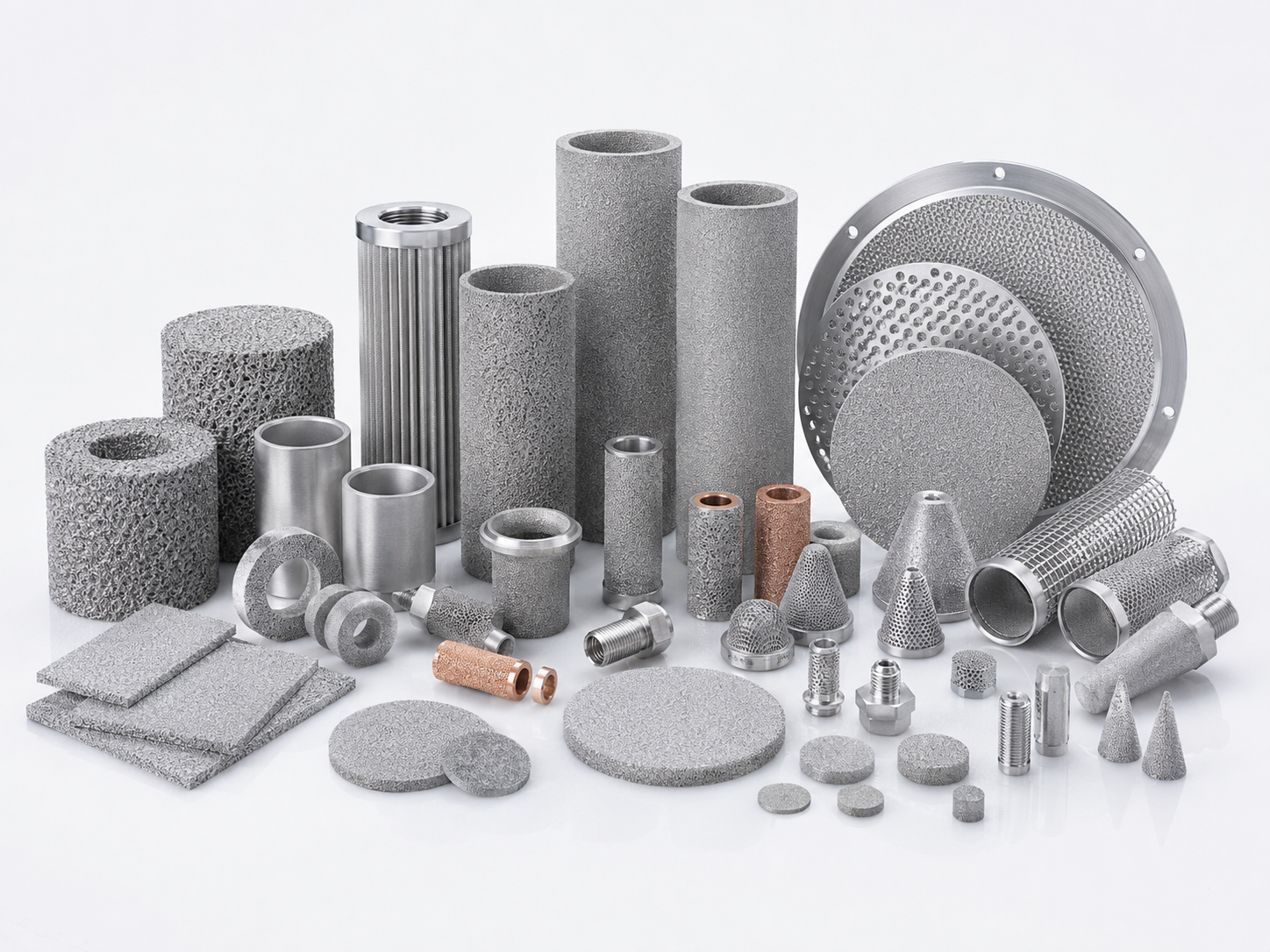
Sintered Metal Filter Elements Made by Drawing, Sample or RFQ
Our factory primarily undertakes drawing-based and sample-based custom metal filter production rather than a fixed stock-parts catalogue. Buyers define the material and media construction, filtration-rating basis, shape, end structure, dimensions, mating connection and service conditions; our manufacturing team then reviews process feasibility, inspection scope and quotation.
For drawings, sample photos, specification sheets or technical files, please email sales@industrialmetalfilters.com directly, without first submitting an RFQ form.
- Custom diameter, length, thickness, end cap, thread and connection design
- Material options such as 316L, 304, bronze, copper powder and titanium by RFQ
- Micron rating selected according to filtration medium, flow and pressure
- Replacement samples, pilot batches and production orders reviewed case by case
Sintered Metal Filter Elements by Structure, Material and RFQ Detail
The right filter element depends on filter media, material grade, filtration rating, surface area, end connection, installation space, medium, temperature, pressure and cleaning method.
| Filter Element Type | Common Materials | Typical Forms | Common RFQ Information |
|---|---|---|---|
| Sintered Metal Filter Cartridges | 316L, 304, stainless steel powder, sintered media | Cartridge, candle, cylinder, threaded element | Length, diameter, end cap, connection, micron rating, pressure and flow requirement |
| Sintered Filter Tubes | Stainless steel, bronze, copper powder, titanium | Tube, porous cylinder, open-ended element, special tube | Outer diameter, inner diameter, wall thickness, length, medium and pressure |
| Sintered Filter Discs | 316L, 304, bronze, copper powder | Round disc, washer shape, flat plate, custom disc | Diameter, thickness, center hole, pore rating, drawing and quantity |
| Custom Sintered Filter Elements | Selected by working condition and factory review | Special-shaped element, welded assembly, replacement filter part | Drawing, sample photo, installation design, medium, temperature and quantity |
Sintered Filter Media Reference by Construction
These are media-family reference ranges, not universal ratings for every finished element. Geometry, joining method, alloy, wall thickness and validation requirements must be checked for the actual order.
| Media construction | Reference filtration grades | Where the reference applies | What requires confirmation |
|---|---|---|---|
| Powder-sintered porous metal | Powder-media nominal grade inquiries commonly include 0.2, 0.5, 2, 5, 10, 20, 40 and 100 μm (examples, not a universal finished-element range) | Industry media reference examples; finished cartridges must be checked by material, shape, thickness and manufacturing method | Selected grade for the specific cartridge, disc or tube; removal efficiency and allowable pressure drop |
| Standard five-layer 316L sintered wire mesh | Approximately 1–100 μm nominal media grades | Standard layered mesh media; finished element may use a different layer arrangement or reinforcement | Exact laminate, shape, edge joining, support and finished filter performance |
| Stainless steel sintered fiber felt | Common catalog media grades include 5, 7, 10, 15, 20, 25, 30 and 40 μm | Selected stainless fiber-felt media, before assembly into a cartridge or pleated element | Media grade, pleat geometry, protection layer, pressure drop and cleaning method |
Do you have a required filtration efficiency?
Please state the target particle size, required removal efficiency and the method by which performance must be verified. A supplier’s media grade alone does not establish an absolute-rated finished element.
Sintered Metal Filter Cartridge Sizes and Micron Grades for RFQ
Use the dimensional examples and nominal media grades below to prepare a cartridge inquiry. Confirm material, porous construction, connection and test requirements for the finished part.
| Illustrative cartridge inquiry | OD × overall length | Example medium / grade request | Connection to define | Key drawing details |
|---|---|---|---|---|
| Compact tubular element | 25.4 × 152 mm | 316L powder / 5 µm nominal | One blind end; threaded adapter | OD, ID, wall, porous length, exact thread and seal |
| Process cartridge | 38.1 × 305 mm | 316L powder / 10 µm nominal | Open-ended; O-ring or end-cap detail | End-fit, housing seat, allowable clean ΔP |
| Long-form cartridge | 50.8 × 610 mm | 316L powder / 20 µm nominal | Blind-end / manifold adapter | Support, flow direction, pressure and temperature |
| Large cylindrical element | 76.2 × 762 mm | Powder or supported mesh / grade by duty | End cap, flange or custom connection | Housing constraints, joined structure and inspection needs |
On a phone, swipe the table horizontally to see all specifications.
For a specified particle-removal efficiency, include the particle challenge and test definition; nominal media grade alone is not an absolute filtration guarantee. For a custom porous tube rather than a cartridge assembly, see porous metal tubes.
Specify Flow, Differential Pressure and Connection Fit Together
An element can match the nominal micron grade and still fail to meet the application’s flow requirement or fit the existing housing. The following inputs make a preliminary engineering review more reliable.
Filtration Performance
Identify the process fluid or gas, particle challenge, required filtration performance and target flow. When pressure loss matters, provide the allowable clean-element differential pressure at that flow.
Why it matters: The same media grade may give different pressure drops when porous area, element thickness or fluid viscosity changes.
Mechanical & Sealing Fit
Give the filter OD/ID, overall length, active media length, end-cap and thread geometry, seal location and flow direction. For an existing housing, share a drawing or photographs of both ends.
Why it matters: A matching outside diameter alone does not establish an interchangeable replacement element.
Operating Limits
Include operating temperature, system pressure, expected differential pressure during service and any reverse-flow or cleaning requirement. Material and joining details must be reviewed as one assembly.
Why it matters: Maximum line pressure and pressure difference across the media are different design conditions.
Cleaning & Reuse
Describe the contaminant, whether the filter will be cleaned in place or removed, and any expected backwash, pulse cleaning or chemical exposure. Cleaning suitability depends on media construction and the final element.
Why it matters: Not every sintered element can be cleaned in the same way or returned to the same performance after service.
- Flow requirement
- State flow rate, gas/liquid, temperature and operating conditions.
- Clean-element ΔP
- Specify a permissible pressure drop at the target flow if critical.
- Line pressure
- Supply the process pressure independently from media differential pressure.
- Mechanical fit
- Include the connection, sealing face, end cap and installation dimensions.
Where Sintered Metal Filter Elements Are Commonly Used
Sintered filter elements are used in industrial equipment where buyers need durable porous metal filtration components instead of disposable paper, plastic or fabric filter media.
Gas and Air Filtration
Used for gas filtration, air filtration, venting, diffusion, silencing and protection of industrial equipment components.
Liquid and Oil Filtration
Used for liquid filtration, oil filtration, process filtration, hydraulic systems and reusable filter assemblies.
Chemical and Process Systems
Stainless steel sintered elements are considered when corrosion resistance, cleanability and stable pore structure are important.
OEM Equipment Protection
Custom filter elements can protect pumps, valves, nozzles, sensors, regulators and industrial process components.
Filter Housings and Assemblies
Cartridge and candle elements can be designed for installation inside existing filter housings or custom filtration systems.
Replacement Filter Projects
Buyers can send old element photos, sample dimensions, drawings or connection details for replacement feasibility review.
Sintered Metal Filter Element Ends, Threads and Seals
A filter’s porous media must work with its mounting system. Confirm the connection and seal before deciding that two cartridge elements are interchangeable.
Blind-End Cartridge
One end closed, the other connected to the housing. Specify the end-cap design, mounting thread or adapter, and direction of filtration.
Open-Ended Element
Both ends open for a defined housing interface. Specify gasket or O-ring faces, end diameters and the supported porous length.
Threaded or Adapter-Mounted Element
Describe thread designation, seal type, weld geometry or flange dimensions. Share the existing adapter or housing drawing when possible.
How to Select a Sintered Metal Filter Element for the Actual Duty
Two elements sold with a similar nominal micron grade may have different flow resistance, mechanical limits and sealing interfaces. Start with the requirement that could make the element unsuitable, then review the media and the complete assembly together.
1. Particle retention
Decide: Is the specification a nominal media grade, a pore-characterization result, or a defined particle-removal efficiency?
Verify: Specify the challenge medium, particle distribution, efficiency criterion and acceptance test. Do not equate a nominal micron number with an absolute rating.
2. Clean flow and pressure loss
Decide: What flow must pass through the complete finished element, at what clean differential pressure?
Verify: Give the working gas or liquid, temperature, viscosity where relevant, flow unit and allowable pressure loss. Geometry, porous area and media resistance must be considered together.
3. Forward and reverse loading
Decide: Is operation outside-in or inside-out, and will backwash or pulse cleaning reverse the loading?
Verify: Record line pressure separately from differential pressure across the porous wall, including expected maxima, direction and any required support or qualification.
4. Corrosion and temperature
Decide: Which material is suitable for the actual chemical medium, concentration, temperature and atmosphere?
Verify: Review media, end fittings, welds and seals as an assembly. A generic alloy temperature figure is not a universal completed-element rating.
5. Cleaning and regeneration
Decide: Will cleaning be by backwash, pulse, ultrasonic treatment, compatible solvent or replacement?
Verify: Agree on cleaning direction, frequency, chemistry, allowable loads and a method for judging restored clean-flow performance. Reuse is application-dependent.
6. Housing and seal fit
Decide: Is the element built for a new vessel or intended as an alternative inside an existing housing?
Verify: Check OD, ID, overall and active porous length, end caps, exact thread designation, gasket or O-ring seat and installation clearances. Similar dimensions do not prove interchangeability.
Engineering decision: If retention, pressure drop, mechanical loading and housing fit cannot all be met by the initial configuration, change the design basis or request application-specific verification. A different micron label alone is not a complete solution.
Dimensions and Interface Details to Include in the Approved Drawing
A purchasable element specification must describe the porous body and the installation hardware. The following fields guide a drawing review; they are not a fixed size series or a claim that every combination is available.
Porous body
Mark outside diameter (OD), inside diameter (ID) where applicable, overall length (OAL), porous wall thickness and active porous length. For pleated media, identify the effective-area definition; the outer envelope is not automatically the tested filtration area.
End fitting and seal
Dimension the thread designation, engagement, flange or adapter, sealing land or O-ring groove, weld location and mating-housing surfaces. Include orientation and any critical fit tolerance on the same drawing revision.
Pressure and service direction
Indicate normal flow direction, permitted reverse flow or cleaning path, internal support where needed and installation clearance. Element pressure loading is not determined by overall system pressure alone.
Purchasing release
Identify the drawing revision, porous construction and alloy, critical acceptance dimensions, agreed test basis, prototype or sample approval status and repeat-order inspection requirements.
Which Inspection or Test Supports Each Filter Element Claim?
Material, pore characterization, particle retention, pressure drop and mechanical integrity are different properties. Buyers can use this matrix to define requested acceptance evidence. Test availability, method and pass criteria must be confirmed for the particular order; this is not a blanket offer of every test or report.
| Property to confirm | Verification to discuss | Buyer-defined conditions | What it does not establish |
|---|---|---|---|
| Alloy and material | Agreed grade specification and material/traceability documentation | Porous body versus hardware, grade and required document type | Efficiency, universal corrosion resistance or rated pressure |
| Dimensions and connection fit | Inspection against the approved drawing and applicable fit review | OD, ID, OAL, end-cap, thread, gasket land, tolerances and drawing revision | Filtration performance or sealing under real load |
| Pore/media characteristic | Application-appropriate bubble point, permeability or another defined method | Wetting medium if relevant, sample, method, temperature and pass criterion | Absolute particle retention without an established relationship |
| Particle-removal performance | Defined particle challenge and efficiency verification where required | Challenge particle size/distribution, test fluid, flow, target and sample basis | Dirt capacity, differential-pressure strength or service life |
| Finished-element clean pressure drop | Flow-versus-differential-pressure measurement on the agreed assembly | Fluid, temperature, viscosity where relevant, flow direction and cleanliness | End-of-life pressure loss, cleaning interval or life expectancy |
| Sealing and mechanical integrity | Agreed leak/integrity or forward/reverse pressure qualification | Test boundary, pressure direction, differential limit and acceptance criterion | Guaranteed strength or interchangeability of another geometry |
RFQ clarification: List mandatory tests and documents separately from preferred checks, and state the relevant conditions and pass values. Supplier media grades, standalone media curves and finished-element acceptance results are not interchangeable.
Inspection and Performance Requirements for Finished Filter Elements
Agree on the acceptance basis for the finished cartridge, not only the filter media. State which checks are required for your purchasing specification so availability and testing can be assessed during quotation.
Material & Dimensions
State alloy grade, element OD/ID, overall length, end fittings, thread or O-ring geometry and any critical tolerances. Identify any required material documents.
Media or Retention
Define nominal grade or the required removal efficiency and particle size. If pore characterization is required, agree on the method and acceptance value before production.
Flow & Pressure Drop
Specify working gas or liquid, test temperature, target flow and allowable clean-element pressure loss; avoid assuming a flat media data point represents a finished cartridge.
Mechanical & Service Duty
Give maximum system and differential pressures, filtration direction, cleaning or reverse flow, temperature and process compatibility. Ask for any needed qualification checks explicitly.
Information Needed to Quote Sintered Metal Filter Elements
For a new element or replacement part, the following information helps the factory review the porous media and mechanical connection together. Unknown fields can be identified as “to confirm”.
1. Filter Media & Material
- Powder-sintered metal, bonded mesh or fiber-felt media
- Requested material grade and process compatibility
- Nominal micron grade or defined removal-efficiency target
- Particle challenge and working liquid or gas
2. Shape & Housing Fit
- Cartridge, candle, disc, tube or special shape
- OD, ID, wall thickness, length and effective porous area where known
- End cap, thread, gasket, mounting and flow direction
- Drawing, sample photo or existing-element reference
3. Process Duty
- Operating flow and allowable clean-element pressure drop
- System pressure, working temperature and medium properties
- Cleaning cycle, backwashing or repeated-use expectations
- Any special inspection or acceptance requirement
4. Purchasing & Production
- Sample quantity and intended production quantity
- Estimated annual demand, if available
- Delivery destination and requested schedule
- Material certificates or inspection documents needed for approval
Replacement-element tip: Include an overall photograph, a close-up of each end connection, housing details and dimensions. If only an old sample is available, filtration performance still needs confirmation; an identical outside shape does not prove an identical pore structure.
Request a Quote for Sintered Metal Filter Elements
To quote accurately, please provide product type and porous media, material, dimensions, end cap or connection, filtration rating or required particle-removal performance, working medium, operating flow, allowable clean-element differential pressure if applicable, line pressure, temperature, drawing details, sample quantity and expected production quantity.
The RFQ form does not upload attachments. If you have drawings, sample photos or technical files, email them to sales@industrialmetalfilters.com.
Explore Sintered Metal Filter Element Configurations
Select a specific form when the component geometry is already known; choose the broader sintered metal filter family to compare media construction.
From Filter Specifications to a Manufacturable Element
A quotation for a porous metal element requires confirmation of both the filtration duty and the physical part. A drawing, actual sample or housing interface information can reduce ambiguity.
Define the Process
Share the filtration target, medium, flow, pressure, temperature and expected cleaning method.
Confirm the Construction
Review powder, mesh or fiber media together with material, geometry, end connection and housing fit.
Review Order Requirements
Confirm feasibility, required qualification or inspection documents, sample quantity and production volume before pricing.
Need an alternative for an existing sintered filter element?
Send the part drawing or photographs with the housing connection, filter dimensions and known performance requirements. You can request an engineering quote or email drawings to our team.
Sintered Metal Filter Elements FAQ
Common questions from industrial buyers before requesting custom sintered metal filter elements.
What information is needed to quote sintered metal filter elements?
Please provide material, structure, dimensions, end connection, micron rating, working medium, temperature, pressure, quantity, application and drawing details if available.
Does METAVOX manufacture custom sintered elements in its own factory?
Yes. METAVOX operates its own metal filter factory and production equipment for custom filtration components. We review cartridge length, diameter, wall and media construction, end caps, connection style, filtration-rating basis, operating duty and inspection method before confirming a production plan and quotation. See our factory and company profile.
Which materials are commonly used for sintered filter elements?
Common options include 316L stainless steel, 304 stainless steel, bronze, copper powder and titanium. Final selection depends on working conditions.
Is a 10 μm media grade the same as 10 μm absolute filtration?
No. Media grades and absolute particle-removal claims use different definitions. If you need a specified efficiency at a given particle size, include the required test or acceptance method in your RFQ.
Why do flow rate and allowable differential pressure matter?
The pressure drop through an element depends on the porous media, wall thickness, effective area, flow and working medium. Please state the target flow and acceptable clean-element pressure drop if restriction is important.
Can an existing sintered metal filter element be replaced from a sample?
An existing part can be reviewed from a drawing, sample photographs, dimensions and end connection. Matching physical dimensions alone is not sufficient to confirm the same filtration grade, flow or service limits.
How should buyers send drawings or sample photos?
The RFQ form does not upload attachments. Please send drawings, sample photos or specification sheets to sales@industrialmetalfilters.com directly; a separate online form submission is not required.
Need Custom Sintered Metal Filter Elements?
Share your element drawing or sample, preferred metal and media structure, dimensions, filtration requirement, operating flow, pressure conditions and planned order quantity. We will review the application and manufacturing feasibility before quoting.