How to Choose a Sintered Metal Filter Element
Choose a sintered metal filter element by balancing particle retention, flow, pressure drop, material compatibility, operating pressure, temperature, cleaning and installation geometry. Selecting only the finest available micron rating is a common way to create unnecessary restriction or short service life.
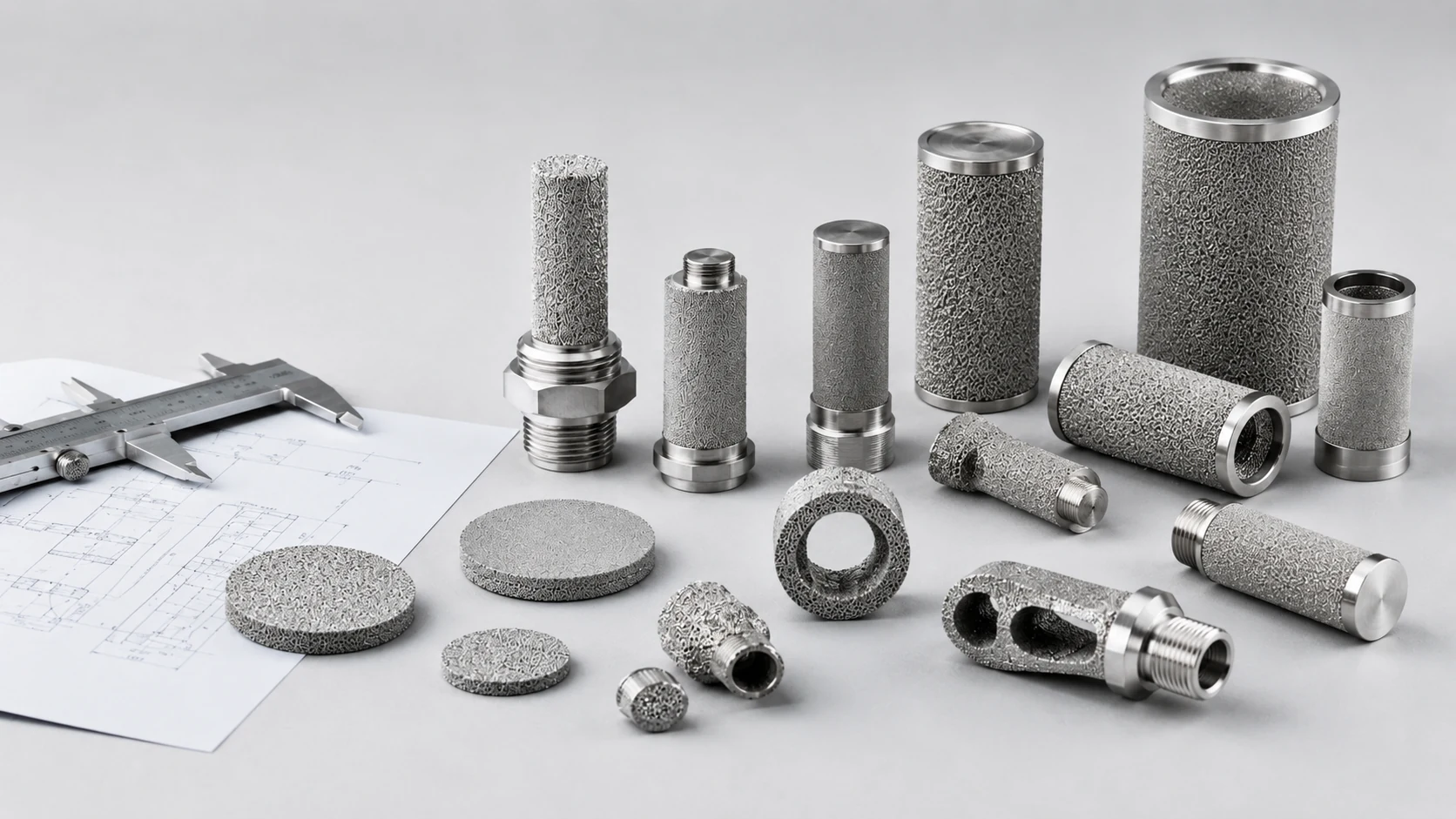
Define What the Filter Must Remove
Start with the separation objective. A useful specification describes the contaminant and downstream protection requirement, not only a single micron number.
Particle Information
Provide particle size distribution if available, contaminant type, concentration and whether solids are hard wear debris, process fines, catalyst particles or another material.
Retention Basis
State whether the requirement is nominal, absolute or based on a specific process or test method. Pore size and filtration rating should not be assumed to be interchangeable.

Balance Flow and Pressure Drop
The porous medium must pass the required flow without consuming too much of the system pressure budget. Media grade, wall thickness and exposed filtration area all affect resistance.
- State normal and maximum flow
- Identify gas or liquid and viscosity if relevant
- Define allowable clean pressure drop
- Define maximum operating differential pressure
- Increase effective area when fine media would otherwise be too restrictive
- Consider how pressure drop will rise as the element loads with contaminants
Select the Media Structure
Powder, sintered wire mesh and metal fiber felt are all durable metal media, but their filtration and cleaning behavior differs.
| Media | Good starting point when | Selection watch-out |
|---|---|---|
| Sintered metal powder | You need a rigid porous disc, tube, cup, cylinder or special shape. | Fine grade + thick wall + small area can create high resistance. |
| Sintered wire mesh | You need a layered reusable screen, cylinder or cartridge with strong support. | Mesh count, aperture and filtration rating are not the same specification. |
| Metal fiber felt | You need depth loading, high porosity or pleated filtration area. | Deeply embedded contamination can be harder to remove completely. |
Check Material, Geometry and Cleaning Before Finalizing
A filter element that works hydraulically still has to survive the medium, fit the housing and recover after contamination.
Material
Match 304, 316L, bronze, copper powder, titanium or other requested materials to the process medium, temperature and cleaning method.
Geometry
Confirm OD, ID, length, wall thickness, connection, flow direction, sealing surfaces and available installation space.
Cleaning
Decide whether the element will be backflushed, ultrasonically cleaned, chemically cleaned or replaced. Cleaning should not be an afterthought.
Six Checks That Turn a Filter Choice into an Orderable Specification
The medium selection is only a starting point. Before approving a cartridge, tube, disc or other element, define which performance and interface details can actually be checked for the proposed finished assembly.
| Decision check | Buyer input | What to confirm before approval |
|---|---|---|
| 1. Particle retention | Contaminant type, size distribution if known and protection target. | Whether the requirement is a nominal or absolute rating, a specified capture efficiency or a method-specific result. Do not substitute a stated pore diameter for measured retention. |
| 2. Clean-flow pressure drop | Normal and peak flow, gas or liquid, viscosity or relevant fluid properties, temperature and allowable initial pressure loss. | The clean-element pressure-drop basis at comparable conditions and effective filtration area. Ask for a matching curve, calculation or agreed sample test when critical. |
| 3. Differential-pressure duty | Operating line pressure, forward/reverse flow, maximum loaded differential and any pulse or backwash events. | The mechanical differential-pressure limits of the complete element and its support or joint design. System line pressure is not the same as pressure difference across the medium. |
| 4. Wetted construction | Fluid chemistry, moisture, chloride or corrosive species, temperature excursions and cleaning chemicals. | Compatibility of media, support, welds or braze, end fittings and any gaskets or seals. A base-alloy temperature limit is not a guarantee for the assembled element. |
| 5. Replacement fit | Approved drawing or sample with OD, ID, active length, thread or cap details, seal seat and flow direction. | Installation clearance, tolerances and bypass-resistant sealing. A matching outside diameter or supplier part number alone does not establish interchangeability. |
| 6. Cleaning and acceptance | Fouling material, backflush or chemical-cleaning plan, inspection request and purchasing quantity. | An agreed terminal pressure-drop or service trigger, a compatible cleaning method and the required post-cleaning inspection or flow recovery basis. Ask which reports can be supplied for this order. |
A media grade, an element rating and an actual application result are different kinds of evidence. The applicable acceptance method, test conditions and records should be agreed for the specific order; no universal filtration efficiency, flow curve or certification is implied here.
What to Reconsider When Two Requirements Conflict
These situations often change the final specification after an initial micron grade or alloy has been selected.
Retention Is Acceptable, but Flow Is Too Low
Recheck the actual fluid, viscosity, active porous area and wall thickness before relaxing the retention objective. A larger area or different supported construction may be worth evaluating; any revision still needs an agreed capture basis.
Media Looks Cleanable, but Performance Does Not Recover
Confirm whether solids build a removable surface cake or enter the media depth. Recovery depends on the contaminant, medium, cleaning direction and method; a reused element should meet the inspection or flow acceptance basis before return to service.
The Alloy Survives, but the Assembly May Not
Check end fittings, seals, joining method and any thermal or cleaning excursions alongside the porous medium. Select compatible wetted parts together instead of treating the alloy’s generic material limit as the cartridge’s operating rating.
The Replacement Fits, but Performance Is Unconfirmed
A matching drawing, sample or part reference can establish an interface to review; it cannot establish equivalent retention, pressure loss or service life. Request the original process duty and decide which tests or acceptance records are needed.
Sintered Metal Filter Element RFQ Checklist
If these fields are known, the first technical review is much more likely to produce a useful recommendation and quotation. For an OEM or replacement element, also agree on the test basis for retention, the fluid and flow conditions for pressure-drop comparison, and housing fit or seal tolerances. Ask which inspection records can be supplied for the confirmed order; a media pore grade alone is not proof of finished-element filtration efficiency.
Process
Working medium, contaminant, temperature and pressure.
Performance
Filtration requirement, flow and allowable pressure drop.
Hardware
Dimensions, connection, material, drawing and housing details.
Lifecycle
Cleaning method, expected quantity and replacement strategy.
Sintered Metal Filter Selection Questions
Common mistakes and practical selection questions.
Should I choose the smallest available micron rating?
No. Choose the rating needed to protect the process. An unnecessarily fine grade can increase pressure drop, reduce flow margin and shorten the operating cycle.
Is pore size the same as filtration rating?
Not automatically. Pore-size descriptions characterize the porous structure, while filtration rating describes retention performance under a defined basis. Ask how the rating is determined.
How do I reduce pressure drop?
Possible levers include using a coarser grade where acceptable, increasing filtration area, reducing wall thickness where mechanically appropriate, changing media structure or reducing flow through each element.
Can I choose by material first?
Material compatibility is essential, but the media structure and geometry still need to satisfy retention, flow, pressure and cleaning requirements.
Need an Application Review?
Send the working medium, contaminant, filtration requirement, flow, allowable pressure drop, pressure, temperature, dimensions, cleaning method and quantity. METAVOX can review the element structure before quotation.
Request an Engineering Quote