Sintered Metal Filter Plates Manufacturer
METAVOX manufactures custom sintered metal filter plates, porous metal plates, porous stainless steel plates and flat porous metal sheet components for industrial gas, liquid, oil, chemical, process and OEM filtration applications.
Plate and sheet components are specified according to material, shape, length, width, thickness, filtration or pore requirement, working medium, operating flow, allowable differential pressure, line pressure, temperature, mounting method, quantity and drawing requirements.
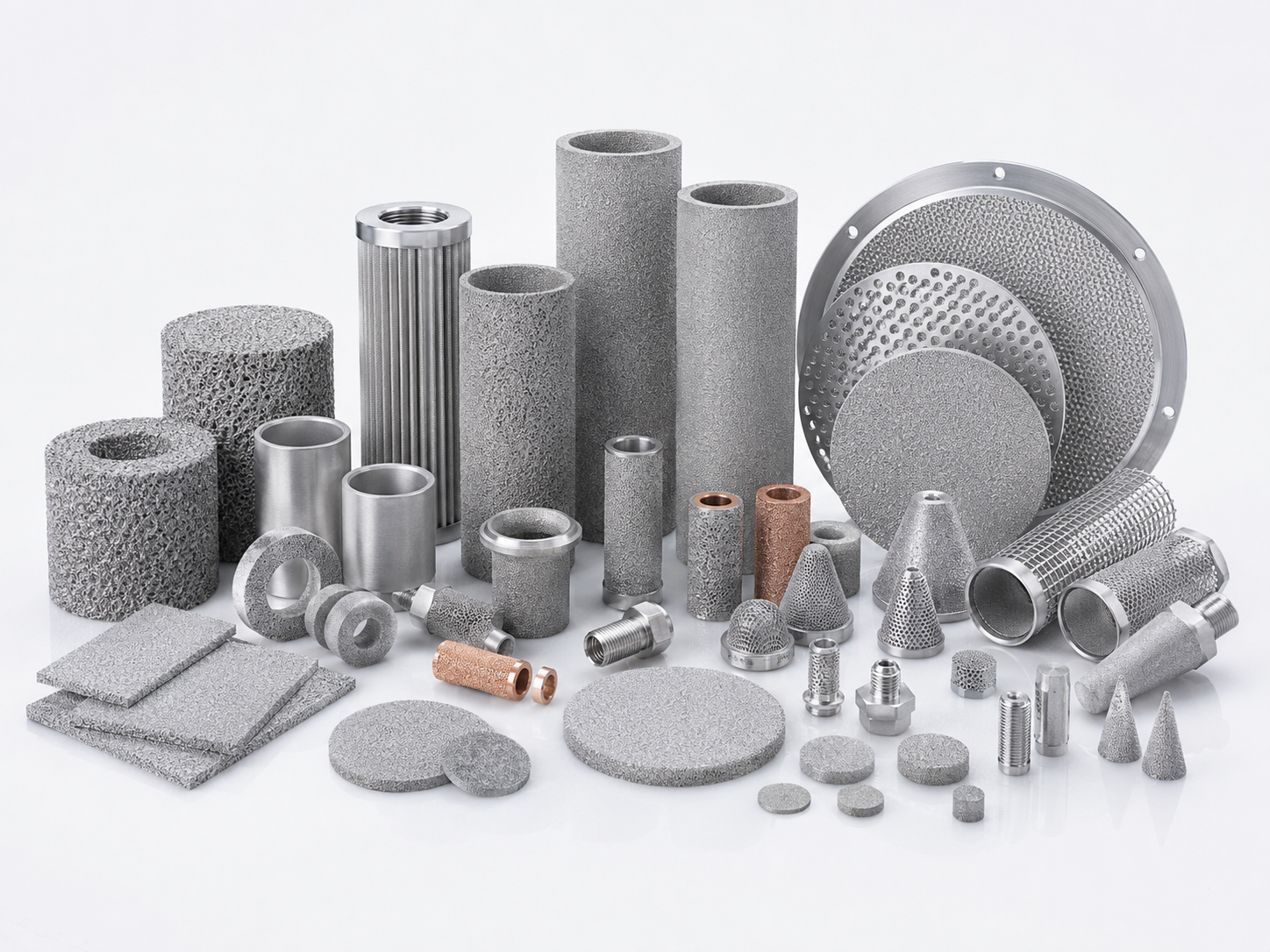
Custom Porous Metal Filter Plates and Sheets
Flat porous metal components are used where the installation requires a defined filtration area, rigid metal construction and custom plate or sheet geometry.
Sintered Stainless Steel Filter Plates
Porous stainless steel plate components for industrial gas, liquid, chemical and process filtration. Exact alloy and material suitability are confirmed according to the application and drawing.
Porous Stainless Steel Sheets
Flat porous stainless steel sheet-type components specified according to dimensions, thickness, filtration requirement and operating conditions.
Rectangular & Special-Shaped Plates
Rectangular, square and custom outlines can be manufactured from drawings, samples, mounting details and equipment requirements.
Custom Plate Thickness
Plate thickness is selected together with pore structure, flow requirement, differential pressure and mechanical requirements.
Custom Filtration & Pore Grades
Nominal grades such as 0.5, 2, 5, 10, 20, 40 and 100 μm may be submitted as reference inquiry options. Availability and retention criteria depend on material, geometry and test definition.
Replacement & Drawing-Based Plates
Existing porous plates can be evaluated from drawings, dimensions, sample photographs or physical samples for replacement projects.

Rigid Porous Metal Structures for Flat Filtration Assemblies
A sintered metal filter plate combines a rigid flat metal form with a controlled porous structure. The finished component must satisfy both the filtration duty and the mechanical requirements of the installation.
Powder-sintered metal filter products can be manufactured from stainless steel, bronze and titanium powder families. Material selection depends on the process medium, corrosion conditions, temperature, geometry and required filtration performance.
- Flat porous metal plate and sheet-type structures
- Stainless steel, bronze and titanium powder-sintered material options subject to project confirmation
- Custom length, width, thickness and plate outline
- Filtration grade selected together with flow and differential-pressure requirements
- Drawing, sample and replacement-part review
Sintered Metal Plate Sizes, Thickness and Porous Media Options
Start with a plate envelope and specify the porous material separately. The configurations below are dimensional examples for quotation—not a stocked-size list or a guarantee that every geometry and grade can be combined.
| Project format | Example length × width × thickness | Geometry to confirm | Primary drawing information |
|---|---|---|---|
| Compact equipment plate | 50 × 50 × 2 mm | Square, full or partly porous face | Corner radius, seating face and edge tolerance |
| Small rectangular plate | 100 × 75 × 3 mm | Plain rectangle or framed panel | Gasket contact width and flow direction |
| Process equipment plate | 150 × 100 × 5 mm | Rectangular porous section | Support layout, unsupported span and maximum ΔP |
| Housing panel | 200 × 150 × 6 mm | Plate with perimeter sealing | Fit, sealing land, bolt locations if applicable |
| Larger panel feasibility inquiry | 300 × 200 × 8 mm | Plate and external support frame | Segmenting options, flatness and support spacing |
On phones, swipe the specification table horizontally. All dimensions are illustrative RFQ combinations in millimetres. Tooling, minimum thickness, porosity, rigidity, flatness, achievable length/width and price depend on the chosen material and manufacturing route.
Illustrative plate and sealing views — not to scale, not approved manufacturing drawings. Confirm L, W and T, gasket overlap, active porous area and support span from the actual drawing.
Material and porous-medium request
Specify 316L stainless steel first when compatible with the process; 304, bronze, titanium or other alloys can be discussed with a detailed application. Powder-sintered plates are not the same construction as laminated sintered wire mesh sheets.
Nominal rating inquiry: 0.5 / 2 / 5 / 10 / 20 / 40 / 100 μm, or a defined removal-efficiency target. The numbers are independent inquiry references, not universally available combinations.
Shape and finishing details
- Rectangular, square or drawing-defined outline
- Edge sealing land, recess or support-frame fit
- Mounting holes or inserts only where feasible
- Defined face orientation and active porous window
- Prototype or replacement plate from an existing sample
How to Specify a Sintered Metal Filter Plate
A useful RFQ should define both the porous filtration requirement and the physical plate geometry.
Stainless Steel, Bronze & Titanium
Powder-sintered metal filter products can be produced from stainless steel, bronze and titanium. Exact material and alloy should be confirmed for the specific plate project.
Nominal Filtration Grades for Review
For inquiry, identify a nominal grade such as 0.5, 2, 5, 10, 20, 40 or 100 μm. Agree on the retention test, flow and pressure drop before confirming a finished plate.
Flow, Area & ΔP Must Be Reviewed Together
Plate area, thickness, porous structure and operating flow all influence finished pressure drop.
| Selection Factor | Why It Matters | Information to Provide |
|---|---|---|
| Material | Material selection should match corrosion, process medium, cleaning method and operating conditions. | Required material, preferred alloy if known, or complete application conditions. |
| Plate / Sheet Shape | The component outline must match the equipment, sealing area and flow path. | Rectangular, square or custom drawing. |
| Length & Width | Overall dimensions determine installation fit and available porous area. | Plate or sheet dimensions and dimensional tolerances if required. |
| Thickness | Thickness influences mechanical structure, porous path length and flow resistance. | Required thickness or dimensions from the existing component. |
| Filtration / Pore Requirement | The selected porous grade must match the process duty and working medium. | Required micron grade, pore specification or defined particle-removal target. |
| Operating Flow | Flow through the available porous area influences finished pressure drop. | Required gas or liquid flow rate. |
| Clean-Filter Differential Pressure | Restriction-sensitive systems require a defined maximum initial ΔP. | Maximum acceptable clean-filter differential pressure at the required flow. |
| System / Line Pressure | System pressure affects the mechanical review of the finished installation. | Normal and maximum system pressure. |
| Temperature | Temperature influences material and finished-component selection. | Normal and maximum process temperature. |
| Working Medium | Gas, liquid, oil and chemical media affect material and pore selection. | Medium, contaminants and process description. |
| Mounting / Sealing | Clamping, gasketing and support can reduce active porous area and affect plate design. | Housing drawing, gasket area, mounting holes, support structure and installation method. |
| Quantity | Quantity influences manufacturing method, setup and quotation. | Prototype, qualification and expected production quantity. |
How Plate Seals and Supports Change the Usable Filtration Area
Specify the active opening, not just overall plate size. A perimeter gasket, mounting frame or support bar can cover part of the porous surface and affect flow, pressure drop and rigidity.
Plan view — overall size & open area
Overall L × W includes the masked perimeter. For uniform edge masking b, the geometric open rectangle is (L − 2b) by (W − 2b), before subtracting any support obstructions. Confirm gasket contact on the actual drawing.
Section view — plate thickness & support
Thickness T is the distance between the two plate faces, not a pressure rating. Unsupported span, frame geometry and differential pressure require separate mechanical review.
Illustrative engineering dimensions only — not to scale and not an approved manufacturing drawing. The actual plate geometry, sealing method and allowable operating conditions must be confirmed by drawing and engineering review.
Calculate a first-pass porous opening
For a rectangular opening with uniform edge masking b, and with no internal support bars:
Aopen = (L − 2b) × (W − 2b)Example: a 200 × 150 mm face with 10 mm masked on each edge leaves an open rectangle of 180 × 130 mm, or 23,400 mm² before subtracting internal supports. That is 78% of the outer 30,000 mm² face.
This is a geometric estimate, not a guaranteed effective filtration area or pressure-drop rating.
Choose an installation approach
- Perimeter clamp and gasket: specify compression, seal material, contact land and retaining frame
- Supported panel: specify support spacing and whether a perforated backing covers part of the face
- Framed replacement: share the old assembly, housing dimensions and tolerance stack
- Bonded or welded interface: requires separate review for material compatibility and sealing integrity
Unlike a round sintered filter disc, a rectangular plate can have a large unsupported span. Higher system pressure is not the same as higher allowable differential pressure across the porous section.
Industrial Applications for Porous Metal Filter Plates
Flat sintered metal plates and porous metal sheets can be used where a rigid porous surface is required for filtration, flow passage or equipment protection.
Gas & Air Filtration
Porous metal plates can be used for gas filtration, air filtration and equipment protection in custom assemblies.
Liquid Filtration
Porous stainless steel plate and sheet structures can support industrial liquid and process filtration.
Oil & Hydraulic Systems
Flat porous metal components can be used for oil, hydraulic and reusable industrial filtration assemblies.
Chemical & Process Filtration
Stainless steel porous plates can be selected where material compatibility, corrosion resistance and cleanable metal construction are required.
OEM Equipment Protection
Custom porous plates can function as internal filtration, flow-control or protection components inside industrial equipment.
Pilot & Custom Equipment
Drawing-based porous plates can be manufactured for laboratory, pilot, testing and special industrial equipment.
Porous Metal Plates, Filter Discs and Sintered Wire Mesh Sheets
These products are all available in flat forms, but their geometry and porous construction are different.
Sintered Metal Filter Plates & Sheets
Select a rigid porous metal plate or sheet-type component when the application requires a flat filtration surface defined by length, width, thickness and porous grade.
Sintered Metal Filter Discs
Round and washer-shaped porous components are specified primarily by outside diameter, thickness and center-hole geometry.
Sintered Wire Mesh Sheets
Sintered wire mesh sheets are manufactured from bonded layers of woven stainless steel mesh. They provide a different filtration structure from rigid powder-sintered porous plates.
Custom Plate Projects by Drawing, Sample and Working Conditions
METAVOX evaluates non-standard porous metal plate and sheet components according to material, dimensions, filtration requirements, operating conditions and installation details.
Porous metal product forms including flat plates, sheet-type components, discs, tubes and custom sintered parts.
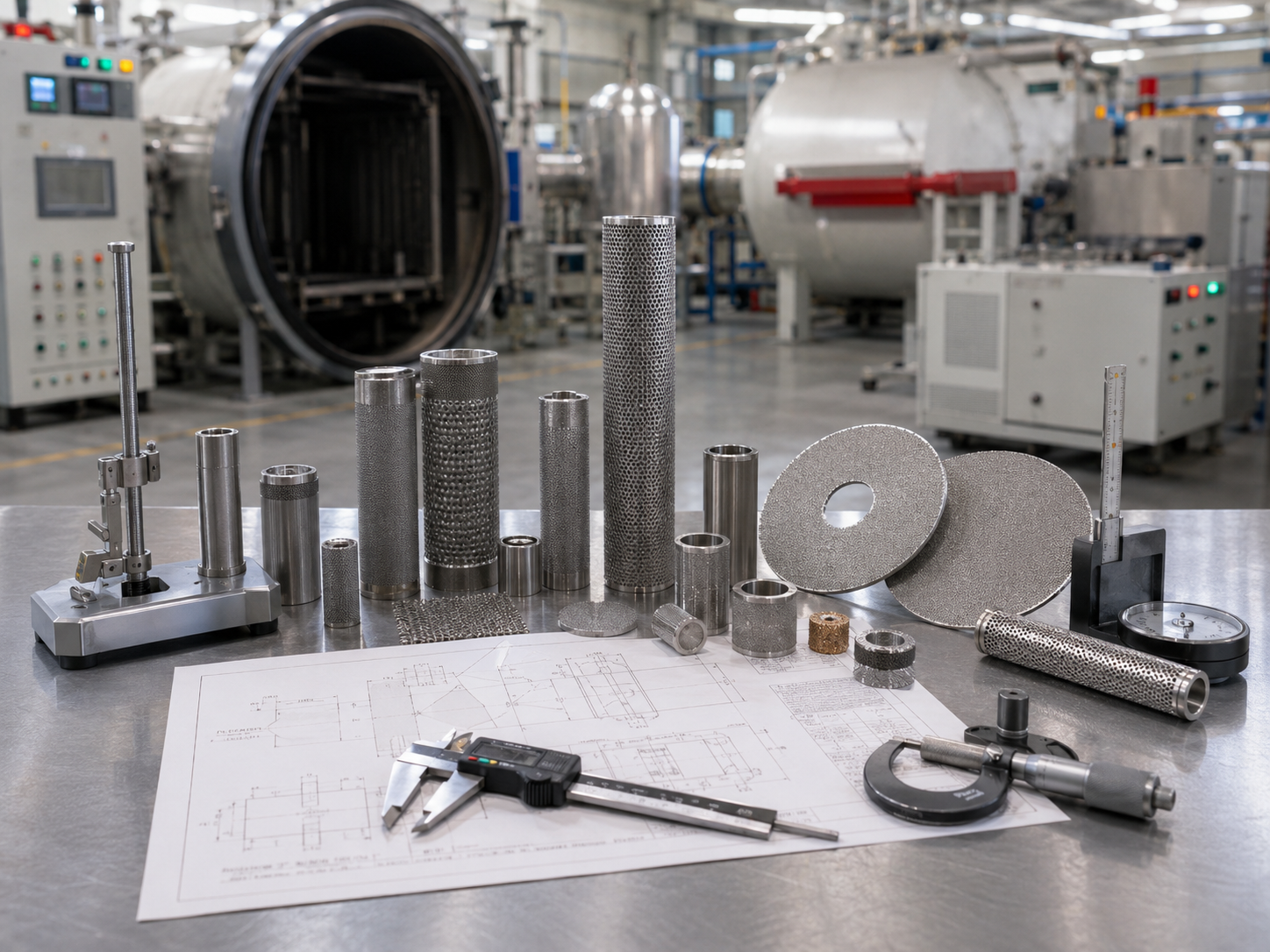
Drawing and dimensional review for custom porous metal and replacement-component projects.
What to Verify Before Approving a Custom Porous Filter Plate
A quotation should define the accepted part—not only the nominal micron grade. Test methods, dimensional tolerances and acceptance limits are selected for the actual medium, assembly and operating conditions.
| Review stage | Engineering evidence or measurement | Agree before sample or batch approval |
|---|---|---|
| Drawing and geometry | Length, width, thickness, edge profile, flatness, hole locations and visible porous window | Controlled drawing revision, datums, dimensional tolerances and inspection locations |
| Material | Selected alloy and any required incoming-material identification | Requested alloy designation and whether material certification is needed |
| Porous-medium grade | Specified nominal rating or a defined retention / pore-characterization method | Test method, target limit and treatment of nominal versus absolute retention |
| Flow and pressure drop | Finished-plate flow versus ΔP at a stated gas/liquid, viscosity, temperature and test setup | Acceptance flow, pressure-drop ceiling and documented test conditions |
| Sealing and assembly | Perimeter contact, frame fit, bypass/leak risk, orientation and support | Assembly drawing and agreed leak or fit check if relevant |
| Prototype to repeat order | Sample record, drawings, revision and any approved reference part | What must remain consistent across subsequent lots |
Inspection items are specification choices to agree during quotation; they are not a claim that every method or certificate is provided automatically.
Request a Custom Sintered Metal Filter Plate Quote
Begin with your drawing or the six main specification groups below. Unknown details can be marked “to confirm” during engineering review.
View the complete 12-field plate RFQ checklist
Select and copy the detailed engineering fields manually when preparing a drawing package or email.
Product: rectangular / square / special-shape porous metal plate
Material / alloy: 316L / 304 / bronze / other: ______
Overall L × W × T (mm): ______ × ______ × ______
Drawing file / revision / tolerances: ______
Nominal grade OR particle-retention target and test: ______
Working medium and temperature: ______
Required flow and maximum clean ΔP: ______
Line pressure and maximum operating ΔP: ______
Sealing contact width / active window: ______
Support frame, holes and mounting method: ______
Prototype quantity / recurring quantity: ______
Inspection or sample-approval requirements: ______
Related Sintered Metal Filter Products
Compare porous metal plates and sheets with related filter geometries, materials and media structures.
Sintered Metal Filter Discs
Round, washer-shaped and custom porous metal disc components.
View Filter Discs →Sintered Metal Filters
Sintered and porous metal filter products in multiple materials, structures and geometries.
View Sintered Metal Filters →Sintered Stainless Steel Filters
Porous stainless steel filters for industrial gas, liquid and process filtration.
View Stainless Filters →Sintered Wire Mesh Filters
Layered stainless steel sintered mesh sheets, discs and filter structures.
View Wire Mesh Filters →Custom Metal Filter Elements
Drawing-based custom discs, tubes, cartridges and porous metal parts.
View Custom Elements →Factory Capabilities
Review METAVOX custom manufacturing, drawing review and inspection capabilities.
View Factory Capabilities →Sintered Metal Filter Plates FAQ
Common purchasing and engineering questions for custom porous metal plate and sheet projects.
What is a sintered metal filter plate?
A sintered metal filter plate is a rigid flat porous metal component used where filtration, controlled flow or equipment protection must be provided through a defined plate area.
What materials are available for porous metal plates?
Powder-sintered metal filter products can include stainless steel, bronze and titanium. Exact material, alloy and suitability for a plate application depend on the working medium, operating conditions, geometry and drawing requirements.
What filtration range is available for powder-sintered metal plates?
Nominal ratings such as 0.5, 2, 5, 10, 20, 40 and 100 μm are useful inquiry references from porous-metal product catalogues. They are not interchangeable with a tested particle-removal efficiency or a confirmed size-by-grade availability list. The finished-plate specification is determined during project review.
Can METAVOX make custom stainless steel filter plates by drawing?
Yes. Custom porous metal components can be evaluated from drawings, samples, dimensions, material requirements, filtration requirements, working conditions and quantity.
What information is needed for a filter plate quotation?
Provide material, plate geometry, filtration duty, service conditions, installation details and quantity. Use the complete plate RFQ checklist for drawing, test and acceptance details.
What is the difference between a filter plate and a filter disc?
A filter disc is primarily round or washer-shaped and is specified by diameter, thickness and center-hole geometry. A filter plate or porous sheet is normally selected for rectangular, square or other broader flat forms.
Is a porous metal sheet the same as a sintered wire mesh sheet?
Not necessarily. A porous metal plate or sheet-type component can use a rigid powder-sintered porous structure, while a sintered wire mesh sheet is manufactured from bonded layers of woven metal mesh. The correct structure depends on the filtration, flow, mechanical and cleaning requirements.
Does micron rating determine the pressure drop of a filter plate?
No. Pressure drop also depends on plate thickness, exposed porous area, operating flow, working medium and porous structure. Flow and allowable ΔP should be specified together when restriction is important.
Does micron rating guarantee particle-removal efficiency?
No. A pore or micron grade does not automatically define particle-removal efficiency at a specific particle size. If efficiency is an acceptance requirement, provide the particle size, target efficiency, operating conditions and test method.
Can a large porous plate operate without a backing support?
Do not assume so from thickness alone. The acceptable unsupported span depends on the alloy, porous structure, differential pressure, mounting design and operating temperature. Provide the support details and maximum differential pressure for a mechanical review.
Need Custom Sintered Metal Filter Plates?
Have a plate drawing or sample and defined filtration duty? Send project details for a manufacturing feasibility and quotation review. Use the plate RFQ checklist for supporting information.